• Skip to primary navigation
  • Skip to main content
  • Skip to footer
Center for Excellence in Assisted Living

Center for Excellence in Assisted Living CEAL@UNC

Advancing the well-being of the people who live and work in assisted living through research, practice, and policy.

  • Home
  • About
    • Assisted Living and CEAL@UNC
    • CEAL@UNC Vision, Mission, and Principles
    • Leadership
    • Advisory Board
    • Strategic Advisors
  • Core Areas and Projects
    • Consumer Core
    • Practice Core
    • Policy Core
    • Research Core
    • Assisted Living Research in Progress
    • Expert Registry
    • CEAL@UNC Research Award
  • Resources
    • CEAL@UNC Resources and Publications
    • CEAL@UNC Affiliate Resources
    • Academic Publications
  • News & Events

Search Center for Excellence in Assisted Living

Quality Improvement

Admission and Discharge Practices Among Assisted Living Communities: The Role of State Regulations and Organizational Characteristics

Aug 1, 2024
WHAT THIS MEANS FOR YOU: This study examined state regulations and characteristics from 250 AL communities in 7 states related to admission and discharge practices and three activities of daily living (ADLs). State regulations were not associated with admission and discharge practices, but communities who were above the mean in staff-resident ratio were 17% more likely to admit residents with feeding difficulties and 25% less likely to discharge them. For-profit facilities were more likely to admit residents with bathing and feeding difficulties. These relationships mean that organizational characteristics may drive admission and discharge practices more than state regulations.
Admission and Discharge Practices Among Assisted Living Communities: The Role of State Regulations and Organizational Characteristics

August 1, 2024 by Lea Efird-Green

WHAT THIS MEANS FOR YOU: This study examined state regulations and characteristics from 250 AL communities in 7 states related to admission and discharge practices and three activities of daily living (ADLs). State regulations were not associated with admission and discharge practices, but communities who were above the mean in staff-resident ratio were 17% more likely to admit residents with feeding difficulties and 25% less likely to discharge them. For-profit facilities were more likely to admit residents with bathing and feeding difficulties. These relationships mean that organizational characteristics may drive admission and discharge practices more than state regulations.
Revolutionizing Patient Surveillance in Assisted Living Facilities: Insights from AUGi Technology Implementation

Jul 1, 2024
WHAT THIS MEANS FOR YOU: The study examined the effectiveness of a remote-surveillance technology (AUGi) to enhance falls surveillance, conduct remote assessments and send out alerts in 3 AL communities in 3 different states. Using data collection, AUGi facilitated a 64% average reduction in falls and had success enhancing nurse surveillance by providing falls notifications.

Revolutionizing Patient Surveillance in Assisted Living Facilities: Insights from AUGi Technology Implementation

July 1, 2024 by Lea Efird-Green

WHAT THIS MEANS FOR YOU: The study examined the effectiveness of a remote-surveillance technology (AUGi) to enhance falls surveillance, conduct remote assessments and send out alerts in 3 AL communities in 3 different states. Using data collection, AUGi facilitated a 64% average reduction in falls and had success enhancing nurse surveillance by providing falls notifications.

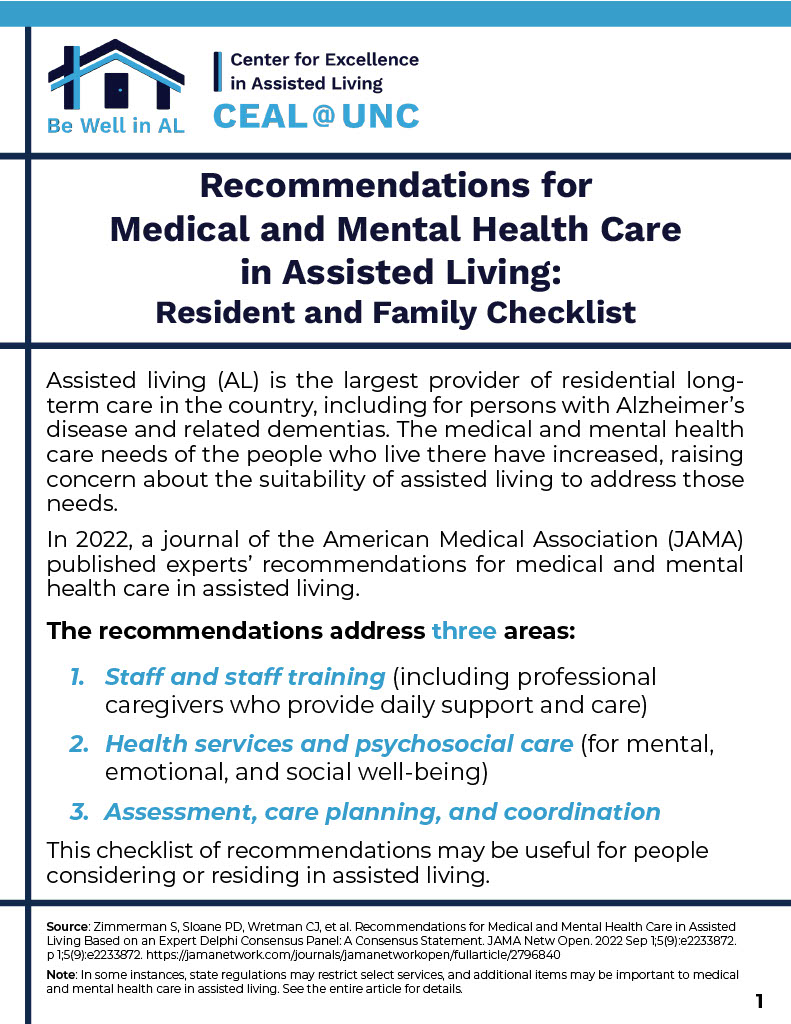
Be Well in AL Recommendations: Resident/Family Checklist

Jun 10, 2024
CEAL@UNC recognizes the benefit of ongoing quality improvement in assisted living, including through the implementation of consensus medical and mental health care recommendations disseminated through the Be Well in AL Initiative. This checklist, to be used by residents and their families considering or residing in assisted living, is a helpful tool to understand recommended care […]

Be Well in AL Recommendations: Resident/Family Checklist

June 10, 2024 by Lea Efird-Green

CEAL@UNC recognizes the benefit of ongoing quality improvement in assisted living, including through the implementation of consensus medical and mental health care recommendations disseminated through the Be Well in AL Initiative. This checklist, to be used by residents and their families considering or residing in assisted living, is a helpful tool to understand recommended care […]

Does Assisted Living Provide Assistance And Promote Living?

May 1, 2024
WHAT THIS MEANS FOR YOU: AL communities in the United States serve more than 918,000 older adults as of 2018. In this commentary, the authors examined how workforce limitations, the complexity of regulations, consumer needs, and lack of financing contribute to negative consequences for aging in place and well-being. They suggest policy changes in those four areas, such as increased staffing, boosting wages and training, encouraging uniform data reporting, and making community disclosure statements more accessible.

Does Assisted Living Provide Assistance And Promote Living?

May 1, 2024 by Lea Efird-Green

WHAT THIS MEANS FOR YOU: AL communities in the United States serve more than 918,000 older adults as of 2018. In this commentary, the authors examined how workforce limitations, the complexity of regulations, consumer needs, and lack of financing contribute to negative consequences for aging in place and well-being. They suggest policy changes in those four areas, such as increased staffing, boosting wages and training, encouraging uniform data reporting, and making community disclosure statements more accessible.

Bioethics in Gerontology: Developing a Typology of Ethical Issues in Assisted Living

May 1, 2024
WHAT THIS MEANS FOR YOU: A team of researchers developed a typology of the ethical conflicts that are likely to exist within AL communities. Drawing on data from a 5-year qualitative study in four ALs for validation, this typology aims to help families, staff, and residents identify and understand ethical best practices in AL communities.

Bioethics in Gerontology: Developing a Typology of Ethical Issues in Assisted Living

May 1, 2024 by Lea Efird-Green

WHAT THIS MEANS FOR YOU: A team of researchers developed a typology of the ethical conflicts that are likely to exist within AL communities. Drawing on data from a 5-year qualitative study in four ALs for validation, this typology aims to help families, staff, and residents identify and understand ethical best practices in AL communities.

Know the Resident: Unlocking Value and Positive Outcomes in Assisted Living Nursing

May 1, 2024
WHAT THIS MEANS FOR YOU: In this editorial, the authors emphasize that addressing social determinants of health in AL communities is crucial for improving residents' well-being and can be accomplished in part through nurse leadership. It presents a framework to address residents’ social needs, focusing on a proactive and holistic approach to care.

Know the Resident: Unlocking Value and Positive Outcomes in Assisted Living Nursing

May 1, 2024 by Lea Efird-Green

WHAT THIS MEANS FOR YOU: In this editorial, the authors emphasize that addressing social determinants of health in AL communities is crucial for improving residents’ well-being and can be accomplished in part through nurse leadership. It presents a framework to address residents’ social needs, focusing on a proactive and holistic approach to care.

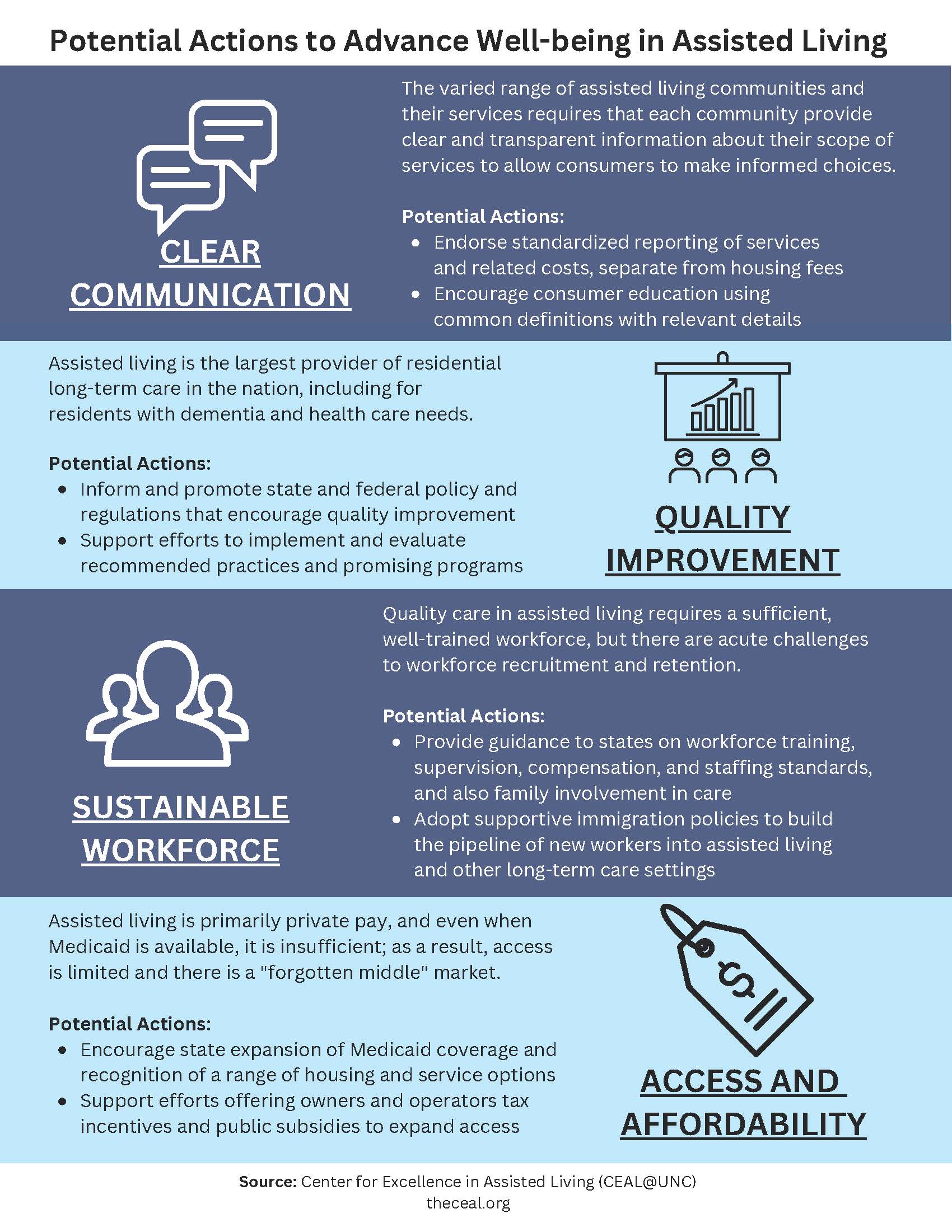
Potential Actions to Advance Well-being in Assisted Living

Apr 23, 2024
CEAL@UNC recognizes the benefit of ongoing quality improvement in assisted living. Numerous feasible solutions have been suggested that may improve care and outcomes in assisted living, including those in this information sheet. Feel free to utilize and distribute this information sheet among your networks to advance the well-being of the people who live and work […]

Potential Actions to Advance Well-being in Assisted Living

April 23, 2024 by Lea Efird-Green

CEAL@UNC recognizes the benefit of ongoing quality improvement in assisted living. Numerous feasible solutions have been suggested that may improve care and outcomes in assisted living, including those in this information sheet. Feel free to utilize and distribute this information sheet among your networks to advance the well-being of the people who live and work […]

A Step Toward Better Care: Understanding What Caregivers and Residents in Assisted Living Facilities Value in Health Monitoring Systems

Apr 1, 2024
WHAT THIS MEANS FOR YOU: Expert interviews, cognitive walkthroughs, and semi-structured interviews were conducted with 7 caregivers and 5 residents from an AL community to understand the role that health monitoring technology plays in their work and lives. Monitoring technology was viewed as a way to reduce caregivers' workload and improve team communication. Residents were open to using the technology, but protecting their privacy and autonomy was a concern for its implementation.

A Step Toward Better Care: Understanding What Caregivers and Residents in Assisted Living Facilities Value in Health Monitoring Systems

April 1, 2024 by Lea Efird-Green

WHAT THIS MEANS FOR YOU: Expert interviews, cognitive walkthroughs, and semi-structured interviews were conducted with 7 caregivers and 5 residents from an AL community to understand the role that health monitoring technology plays in their work and lives. Monitoring technology was viewed as a way to reduce caregivers’ workload and improve team communication. Residents were open to using the technology, but protecting their privacy and autonomy was a concern for its implementation.

Quality of Life in Assisted Living Facilities for Seniors: A Descriptive Exploratory Study

Mar 1, 2024
WHAT THIS MEANS FOR YOU: Seventeen residents in two AL communities were interviewed about their perceived quality of life. Their perspectives reflected an emphasis on the physical environment, social environment, and home-like atmosphere. The two major indicators of quality of life in the AL community were the resident’s ability to adapt to change and the community’s ability to meet residents’ diverse needs.

Quality of Life in Assisted Living Facilities for Seniors: A Descriptive Exploratory Study

March 1, 2024 by Lea Efird-Green

WHAT THIS MEANS FOR YOU: Seventeen residents in two AL communities were interviewed about their perceived quality of life. Their perspectives reflected an emphasis on the physical environment, social environment, and home-like atmosphere. The two major indicators of quality of life in the AL community were the resident’s ability to adapt to change and the community’s ability to meet residents’ diverse needs.

Worse Quality at For-Profit Assisted Living Facilities in Non-Urban Minnesota

Feb 1, 2024
WHAT THIS MEANS FOR YOU: This study examined the results of licensure surveys for 292 AL communities in non-urban Minnesota between 2021 and 2023. All AL communities received at least one citation, with an average of 15 citations. Citations were most commonly related to meals (e.g., not providing nutritious meals) and fire protection (e.g., safety and evacuation plans). The average number of citations and resulting fines were higher in for-profit communities than in non-profit/government communities.

Worse Quality at For-Profit Assisted Living Facilities in Non-Urban Minnesota

February 1, 2024 by Lea Efird-Green

WHAT THIS MEANS FOR YOU: This study examined the results of licensure surveys for 292 AL communities in non-urban Minnesota between 2021 and 2023. All AL communities received at least one citation, with an average of 15 citations. Citations were most commonly related to meals (e.g., not providing nutritious meals) and fire protection (e.g., safety and evacuation plans). The average number of citations and resulting fines were higher in for-profit communities than in non-profit/government communities.

A Collaborative Approach to Improving Care Outcomes for Residents in Assisted Living

Jan 1, 2024
WHAT THIS MEANS FOR YOU: A longitudinal study of 50 residents and 119 care partners in 8 AL communities in Georgia over 2 years examined the concept of a “care convoy” (a dynamic network of formal and informal care partners) for AL residents. This model was supported by formal and informal interviewing, participant observation, and record review. The model is recommended for use by physicians and other healthcare providers to assist them in supporting the needs and goals of the residents and their care convoys, which is theorized to achieve better care outcomes.

A Collaborative Approach to Improving Care Outcomes for Residents in Assisted Living

January 1, 2024 by Lea Efird-Green

WHAT THIS MEANS FOR YOU: A longitudinal study of 50 residents and 119 care partners in 8 AL communities in Georgia over 2 years examined the concept of a “care convoy” (a dynamic network of formal and informal care partners) for AL residents. This model was supported by formal and informal interviewing, participant observation, and record review. The model is recommended for use by physicians and other healthcare providers to assist them in supporting the needs and goals of the residents and their care convoys, which is theorized to achieve better care outcomes.

Measuring Older Adults’ Wellbeing When Transitioning into Assisted Living Facilities: A Confirmatory Factor Analysis of the Mueller Assessment of Transition (MAT)

Dec 1, 2023
WHAT THIS MEANS FOR YOU: A study of the Mueller Assessment of Transition (MAT) tool in108 older adults in the U.S. who were transitioning into assisted living communities found that the MAT effectively measured wellbeing impact across regions and was internally consistent. Results suggests that the MAT could be a valuable tool for assessing the wellbeing of older adults during the transition to assisted living.

Measuring Older Adults’ Wellbeing When Transitioning into Assisted Living Facilities: A Confirmatory Factor Analysis of the Mueller Assessment of Transition (MAT)

December 1, 2023 by Lea Efird-Green

WHAT THIS MEANS FOR YOU: A study of the Mueller Assessment of Transition (MAT) tool in108 older adults in the U.S. who were transitioning into assisted living communities found that the MAT effectively measured wellbeing impact across regions and was internally consistent. Results suggests that the MAT could be a valuable tool for assessing the wellbeing of older adults during the transition to assisted living.

Older Adults’ Experiences of Participation in Daily Activities in Swedish Assisted Living

Nov 1, 2023
WHAT THIS MEANS FOR YOU: Eleven older adults interviewed in two assisted living communities in Sweden reported their feelings regarding participation and decision-making in daily activities, such as routine personal and medical care. In a qualitative analysis, residents actively participating in these activities reported they led to feelings of happiness, connection, involvement and safety. However, the organization and work environment dictated the ability of care and nursing staff to involve residents in daily activities, a challenge of which the residents were also aware.

Older Adults’ Experiences of Participation in Daily Activities in Swedish Assisted Living

November 1, 2023 by Lea Efird-Green

WHAT THIS MEANS FOR YOU: Eleven older adults interviewed in two assisted living communities in Sweden reported their feelings regarding participation and decision-making in daily activities, such as routine personal and medical care. In a qualitative analysis, residents actively participating in these activities reported they led to feelings of happiness, connection, involvement and safety. However, the organization and work environment dictated the ability of care and nursing staff to involve residents in daily activities, a challenge of which the residents were also aware.

Identifying a National Cohort of Medicare Beneficiaries Residing in Assisted Living Settings: An Updated Method

May 1, 2023
WHAT THIS MEANS FOR YOU: A new methodology was developed for identifying Medicare beneficiaries residing in licensed AL communities in the US using zip code data, Medicare enrollment data, and claims data, and exclusion based on AL capacity (licensing information). Results suggested that using licensing information makes identifying AL residents receiving Medicare more accurate, which could inform research and policy by providing new insights into the health of AL residents.

Identifying a National Cohort of Medicare Beneficiaries Residing in Assisted Living Settings: An Updated Method

May 1, 2023 by Lea Efird-Green

WHAT THIS MEANS FOR YOU: A new methodology was developed for identifying Medicare beneficiaries residing in licensed AL communities in the US using zip code data, Medicare enrollment data, and claims data, and exclusion based on AL capacity (licensing information). Results suggested that using licensing information makes identifying AL residents receiving Medicare more accurate, which could inform research and policy by providing new insights into the health of AL residents.

Fall Prevention Care Management: Implementation and Outcomes of a Project to Reduce Fall Risks of Older Adults in Assisted Living Facilities

May 1, 2023
WHAT THIS MEANS FOR YOU: In this study, undergraduate nursing students implemented a 6-week Fall Prevention Care Management intervention for 25 residents in two AL communities. The intervention included individualized care using motivational interviewing and behavioral change related to fall prevention, as well as helping residents reflect on their perceptions of fall prevention. Qualitative analysis suggested that individualized support improved residents’ opinions of the intervention and facilitated participation for residents at high risk of falls.

Fall Prevention Care Management: Implementation and Outcomes of a Project to Reduce Fall Risks of Older Adults in Assisted Living Facilities

May 1, 2023 by Lea Efird-Green

WHAT THIS MEANS FOR YOU: In this study, undergraduate nursing students implemented a 6-week Fall Prevention Care Management intervention for 25 residents in two AL communities. The intervention included individualized care using motivational interviewing and behavioral change related to fall prevention, as well as helping residents reflect on their perceptions of fall prevention. Qualitative analysis suggested that individualized support improved residents’ opinions of the intervention and facilitated participation for residents at high risk of falls.

Interprofessional care in a retirement and assisted living community: the complexity of teamwork

Apr 1, 2023
WHAT THIS MEANS FOR YOU: Face-to-face interviews with healthcare professionals, group meetings, and participant observation were used to examine interprofessional care teamwork in one community that combines independent living, AL, and skilled nursing. Organizational context, care setting factors, and reimbursement programs like Medicare and Medicaid affected teamwork in different ways; for example, co-location of services in a building did not necessarily ensure teamwork among care providers. Additionally, mission-driven investment in care was not sufficient to ensure teamwork. Thus, teamwork in communities that have different levels of care must be specifically considered when creating organizational policies and procedures.

Interprofessional care in a retirement and assisted living community: the complexity of teamwork

April 1, 2023 by Lea Efird-Green

WHAT THIS MEANS FOR YOU: Face-to-face interviews with healthcare professionals, group meetings, and participant observation were used to examine interprofessional care teamwork in one community that combines independent living, AL, and skilled nursing. Organizational context, care setting factors, and reimbursement programs like Medicare and Medicaid affected teamwork in different ways; for example, co-location of services in a building did not necessarily ensure teamwork among care providers. Additionally, mission-driven investment in care was not sufficient to ensure teamwork. Thus, teamwork in communities that have different levels of care must be specifically considered when creating organizational policies and procedures.

Robots in Assisted Living Facilities: Scoping Review

Mar 1, 2023
WHAT THIS MEANS FOR YOU: There is a persisting staffing shortage in long-term care, and the use of robots in AL shows promise in relieving some staffing pressures. This systematic review found benefits of using robots to improve social interaction, emotional regulation, and fall prevention; however, some studies found barriers to robot use and inconclusive results. Overall, the quality of many of the studies was questionable, and more rigorous studies are needed to understand the impact of robots on AL staff and residents.

Robots in Assisted Living Facilities: Scoping Review

March 1, 2023 by Lea Efird-Green

WHAT THIS MEANS FOR YOU: There is a persisting staffing shortage in long-term care, and the use of robots in AL shows promise in relieving some staffing pressures. This systematic review found benefits of using robots to improve social interaction, emotional regulation, and fall prevention; however, some studies found barriers to robot use and inconclusive results. Overall, the quality of many of the studies was questionable, and more rigorous studies are needed to understand the impact of robots on AL staff and residents.

Well-being of professional older adults’ caregivers in Alberta’s assisted living and long-term care facilities: a cross-sectional study

Feb 1, 2023
WHAT THIS MEANS FOR YOU: A study in AL and other long-term care communities in Alberta assessed nurses’ and professional care aides’ physical, mental, and emotional health, behavior, stress, quality of life, turnover, and absenteeism. Mental and emotional health, quality of life, and stress related to turnover and absenteeism. Although 68% of caregivers reported being satisfied with their general health, they experienced heavy workloads and high stress. These issues may result in decreased job satisfaction, absenteeism, and higher turnover.

Well-being of professional older adults’ caregivers in Alberta’s assisted living and long-term care facilities: a cross-sectional study

February 1, 2023 by Lea Efird-Green

WHAT THIS MEANS FOR YOU: A study in AL and other long-term care communities in Alberta assessed nurses’ and professional care aides’ physical, mental, and emotional health, behavior, stress, quality of life, turnover, and absenteeism. Mental and emotional health, quality of life, and stress related to turnover and absenteeism. Although 68% of caregivers reported being satisfied with their general health, they experienced heavy workloads and high stress. These issues may result in decreased job satisfaction, absenteeism, and higher turnover.

Digital Immunization Tracking in Long-Term Care and Assisted Living Facilities

Feb 1, 2023
WHAT THIS MEANS FOR YOU: Vaccines are a part of the solution to infectious disease outbreaks like COVID-19, but not everyone is getting them, especially older adults. In a Canadian study, pneumonia vaccine uptake was improved by providing assisted living and long-term care communities with vaccine coverage data and providing automatic reminders for subsequent doses. Therefore, a cloud-based digital vaccination record is one solution to promote the uptake of adult vaccines for older adults, as well as tracking immunization records and sharing them with policymaking organizations. This can improve communication and inform policymakers to reduce the risk of infection in AL communities.

Digital Immunization Tracking in Long-Term Care and Assisted Living Facilities

February 1, 2023 by Lea Efird-Green

WHAT THIS MEANS FOR YOU: Vaccines are a part of the solution to infectious disease outbreaks like COVID-19, but not everyone is getting them, especially older adults. In a Canadian study, pneumonia vaccine uptake was improved by providing assisted living and long-term care communities with vaccine coverage data and providing automatic reminders for subsequent doses. Therefore, a cloud-based digital vaccination record is one solution to promote the uptake of adult vaccines for older adults, as well as tracking immunization records and sharing them with policymaking organizations. This can improve communication and inform policymakers to reduce the risk of infection in AL communities.

Now You’re Tax‐Exempt, Now You’re Not: Property Taxation of Assisted Living Facilities

Jan 1, 2023
WHAT THIS MEANS FOR YOU: Nonprofit AL communities in Florida lost their tax-exempt status in 2006 and regained it in 2017. Even when nonprofit AL communities had to pay property taxes, they provided higher-quality services than for-profit communities: more nursing staff, residents, and variety in care. In contrast, for-profit AL communities had more substantiated complaints and deficiencies, faced more sanctions after inspections, and incurred higher fines on average.

Now You’re Tax‐Exempt, Now You’re Not: Property Taxation of Assisted Living Facilities

January 1, 2023 by Lea Efird-Green

WHAT THIS MEANS FOR YOU: Nonprofit AL communities in Florida lost their tax-exempt status in 2006 and regained it in 2017. Even when nonprofit AL communities had to pay property taxes, they provided higher-quality services than for-profit communities: more nursing staff, residents, and variety in care. In contrast, for-profit AL communities had more substantiated complaints and deficiencies, faced more sanctions after inspections, and incurred higher fines on average.

Feasibility study of student-led fall prevention care management: Reducing fall risks in assisted living facilities

Jan 1, 2023
WHAT THIS MEANS FOR YOU: In two AL communities, twenty-five adults over the age of 65 or who fell in the previous year evaluated a student-led Fall Prevention Care Management (FPCM) program. Despite some positive outcomes (improved fall prevention behaviors and reduced fear of falling), there were some limitations, including disinterest in fall prevention from some participants. However, participants rated the program highly, meaning student-run fall prevention programs may be effective for some AL residents.

Feasibility study of student-led fall prevention care management: Reducing fall risks in assisted living facilities

January 1, 2023 by Lea Efird-Green

WHAT THIS MEANS FOR YOU: In two AL communities, twenty-five adults over the age of 65 or who fell in the previous year evaluated a student-led Fall Prevention Care Management (FPCM) program. Despite some positive outcomes (improved fall prevention behaviors and reduced fear of falling), there were some limitations, including disinterest in fall prevention from some participants. However, participants rated the program highly, meaning student-run fall prevention programs may be effective for some AL residents.

Are Online Reviews of Assisted Living Communities Associated with Patient-Centered Outcomes?

Dec 1, 2022
WHAT THIS MEANS FOR YOU: Findings from this study suggest that AL's online reviews may signal quality of care issues, offering consumers information to make more informed decisions in their AL selection, and that reviews may offer insight into residents' perspectives. However, ratings should not replace, but rather complement, other traditional ways of assessing resident experiences because of rating system limitations. Additionally, ratings may assist providers in making improvements to their ALs based on resident feedback, and function as a data source for policymakers about AL quality of care.

Are Online Reviews of Assisted Living Communities Associated with Patient-Centered Outcomes?

December 1, 2022 by Lea Efird-Green

WHAT THIS MEANS FOR YOU: Findings from this study suggest that AL’s online reviews may signal quality of care issues, offering consumers information to make more informed decisions in their AL selection, and that reviews may offer insight into residents’ perspectives. However, ratings should not replace, but rather complement, other traditional ways of assessing resident experiences because of rating system limitations. Additionally, ratings may assist providers in making improvements to their ALs based on resident feedback, and function as a data source for policymakers about AL quality of care.

Patient Safety Culture in Assisted Living: Staff Perceptions and Association with State Regulations

Dec 1, 2022
WHAT THIS MEANS FOR YOU: A total of 714 administrators and direct care workers in 257 assisted living communities reported that direct care workers had a more negative perception of patient safety culture (PSC) than administrators. Stricter state regulations, particularly regarding staffing, were associated with better perceptions of PSC among direct care workers.

Patient Safety Culture in Assisted Living: Staff Perceptions and Association with State Regulations

December 1, 2022 by Lea Efird-Green

WHAT THIS MEANS FOR YOU: A total of 714 administrators and direct care workers in 257 assisted living communities reported that direct care workers had a more negative perception of patient safety culture (PSC) than administrators. Stricter state regulations, particularly regarding staffing, were associated with better perceptions of PSC among direct care workers.

Survey Deficiencies as Quality Indicators in Oregon Assisted Living Communities

Oct 1, 2022
WHAT THIS MEANS FOR YOU: Almost 80% of inspections from 526 assisted living communities in Oregon revealed at least one deficiency; the most common deficiency types were medications and medical treatments, monitoring changes in residents' conditions, and health services. Characteristics associated with more deficiencies included larger size, memory care designation, shorter administrator tenure, and for-profit status. The number and likelihood of a given community receiving a deficiency decreased over the study period (2008-2016).

Survey Deficiencies as Quality Indicators in Oregon Assisted Living Communities

October 1, 2022 by Lea Efird-Green

WHAT THIS MEANS FOR YOU: Almost 80% of inspections from 526 assisted living communities in Oregon revealed at least one deficiency; the most common deficiency types were medications and medical treatments, monitoring changes in residents’ conditions, and health services. Characteristics associated with more deficiencies included larger size, memory care designation, shorter administrator tenure, and for-profit status. The number and likelihood of a given community receiving a deficiency decreased over the study period (2008-2016).

  • « Go to Previous Page
  • Page 1
  • Page 2
  • Page 3
  • Go to Next Page »

Footer

Contact

CEAL@UNC
325 Pittsboro Street
Chapel Hill, NC 27599-3550
Email: CEAL@office.unc.edu
UNC School of Social Work Logo

Connect

  • Facebook
  • LinkedIn

Featured Resource

Copyright © 2026 · Center for Excellence in Assisted Living · All Rights Reserved · Website by Tomatillo Design
