WHAT THIS MEANS FOR YOU: This qualitative analysis applied the Agency for Healthcare Research and Quality’s safety domains to post-2019 health inspection reports from assisted living communities in Minnesota to better understand regulation and safety. Three themes emerged in survey violations that harmed patients: staffing, compliance, and communication. Improving policies and practices related to these domains could improve safety for residents in Minnesota AL communities.
Quality Improvement
Salutogenic Architecture, Non-Therapeutic Environments and the Health of the Elderly: A Systematic Review
WHAT THIS MEANS FOR YOU: This systematic review of 26 articles aimed to identify architectural elements that can achieve salutogenic (positive wellbeing) goals for older adults, and how architectural design can bring salutogenic theory to life. Physical elements such as porches, balconies, and above-grade entrances are key elements in individuals’ homes, while walls were identified as key elements in assisted living communities for supporting coherence due to their role in creating a personal, distinct space for residents.
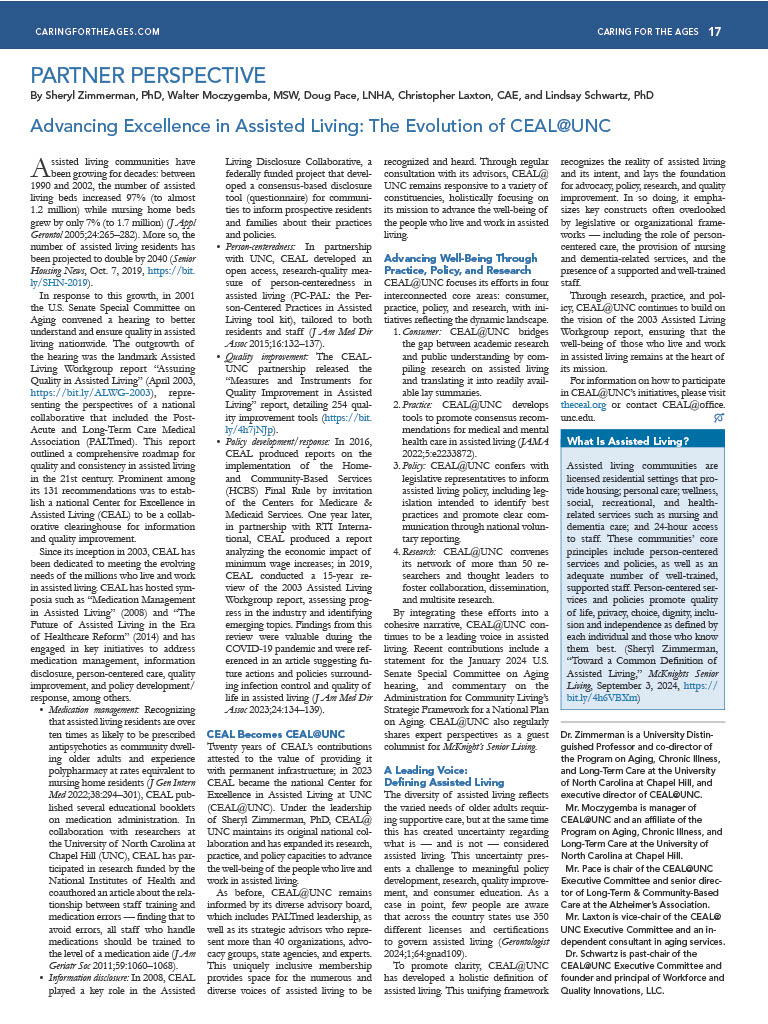
Advancing Excellence in Assisted Living: The Evolution of CEAL@UNC
“Nobody Can Be Equipped for This”: Advice from New Residents of Long-Term Care Facilities
WHAT THIS MEANS FOR YOU: This study involved interviews with 14 residents from a community offering assisted living (AL) and nursing home (NH) levels of care in California to understand residents’ perspectives on moving into a long-term care community. Moving due to unexpected health crises was common. Advice for future residents included preparing for moving, avoiding moving, and acceptance of moving. Staff should be prepared to care for residents who often move due to unforseen/unwanted circumstances.
Keeping Assisted Living Communities Secure: A Comprehensive Approach from the Perimeter to the Interior
WHAT THIS MEANS FOR YOU: This article highlights the importance of physical and cybersecurity in assisted living using the People, Programs, Training, and Technology (P2T2) system. For the system to be effective, staff training, resident education, and collaboration with law enforcement are integral. Best practices like checklists can be implemented so that physical security, technological solutions, and emergency preparedness can be addressed for quality assurance.
Two New Positive Psychosocial Measures for Persons Living with Dementia
WHAT THIS MEANS FOR YOU: Two pilot studies created and tested two new instruments for evaluating wellbeing for people living with dementia, the Living Well Inventory for Dementia (LWI-D) and the Quality of Day Scale (QODS). Seventeen individuals with early-stage dementia tested the LWI-D, and 30 care dyads tested the QODS. Both measures were supported for acceptability and feasibility, with initial support for reliability and validity; further testing of the instruments is recommended.
What Happens Behind Closed Doors? Investigating Care Practices in Nursing Home and Assisted Living Memory Care Units
WHAT THIS MEANS FOR YOU: This study investigated care practices in memory care units using data from the 2021 Biennial Survey of Ohio Long-Term Care Facilities. Analysis revealed that about 20% of nursing homes and AL communities had memory care units, and that physician monitoring, staffing, and adoption of practices and policies were similar in both settings, but that psychotropic medications were used more frequently in NH memory care units. This analysis indicates that improving memory care may require different interventions in NH vs. AL settings.
A Cluster Randomized Controlled Trial of Visual Cues, Signage, and Spaced Retrieval for Wayfinding Within Long-Term Care Communities
WHAT THIS MEANS FOR YOU: This randomized control trial of 172 residents in 15 long-term care communities in two midwestern states to examine the impact of cues and signage, with or without spaced retrieval (SR), a memory strategy to improve wayfinding within communities. For simple routes, cues improved wayfinding. SR with cues reduced the number of errors participants made the most, but cues alone also lowered errors in wayfinding, supporting the potential implementation of cues and signage to reduce wayfinding errors in communities.
Measurement of Quality in Assisted Living in the United States of America: A Scoping Review
WHAT THIS MEANS FOR YOU: This scoping review examined 49 peer-reviewed and 45 gray literature articles from 2009-2019 to assess approaches to, and indicators of, quality in assisted living. After thematic analysis, nine domains emerged, with resident qualiy of life and satisfaction being the most prioritized. These nine domains may help inform future standardized quality measurement for AL settings.
Risk of Hospitalization Among Assisted Living Residents Dually Enrolled in Medicare and Medicaid
WHAT THIS MEANS FOR YOU: This retrospective cohort study used Medicare data from 2008-2018 from 12,451 AL communities to examine the risk of hospitalization for Medicare-Medicaid dual eligibles. Out of 620,542 Medicare beneficiaries, the 1-year risk of hospitalization was higher for dually enrolled individuals. The risk was higher in high-dual AL communities than in low-dual AL communities for both dually enrolled (7.4%) and Medicare only (9.4%) individuals.
Transitions to Nursing Homes Among Residents of Assisted Living and Community-Dwelling Home Care Recipients
This Canadian cohort study included 10,012 AL residents and 131,679 home care recipients who applied for beds in nursing homes to examine the transition differences between the 2 groups. There were 6,049 transitions from AL residents and 85,190 from home care to nursing homes. Living in an AL, rather than in the community, led to a roughly 13% decrease in the 5-year risk of transition to nursing homes despite similar relative clinical complexity and healthcare needs, meaning that assisted living is an important part of the long-term care continuum.
Association Between Organizational Context and Resident Pain in Assisted Living: A Repeated Cross-Sectional Study
WHAT THIS MEANS FOR YOU: This repeated cross-sectional study linked survey data from COVID-19 waves 1 and 2 from 985 residents in 41 AL communities (wave 1) and 1134 residents in 42 AL communities (wave 2) to examine if organizational context was associated with resident pain. Overall pain prevalence decreased from 20.6% in wave 1 to 19.1% in wave 2, but it was non-significant.There were mixed results: better preparedness, room confinement, availability of a nurse practitioner, and staff shortages were associated with resident pain. Organizational context does therefore have an effect on resident pain, and future policy and management interventions should address these factors.
Effect of a Digital Two-Dimensional Animation Program on Attitude Toward Walking Aids, Performance, and Fall Avoidance Behaviors among Older Adults in Assisted Living Facilities
WHAT THIS MEANS FOR YOU: This quasi-experimental study of 128 AL residents investigated the impact of a two-dimensional animation program on attitudes towards walking aids, performance and fall avoidance behaviors. The intervention group had more positive attitudes towards walking aids, improved walking aid use, and reduced fall concerns than the control group, meaning this teaching strategy could be effective to enhance mobility and reduce falls in this setting.
Clinical and Sociodemographic Characteristics of New Residents of Assisted Living: A Nested Case-Control Study
WHAT THIS MEANS FOR YOU: This nested case-control study in Ontario examined differences between community-dwelling and new AL residents to understand transitions to AL communitiess. New residents had higher rates of diagnosed dementia, mood disorders, cardiac arrhythmias, mild cognitive impairment, and falls than community-dwelling peers. New AL residents also had lower odds of having a spousal caregiver than a child caregiver. However, these residents also had higher rates of participation in activities of interest in the last seven days.
Factors Associated with Transfer from Assisted Living Facilities to a Nursing Home: National Health Aging Trends Study 2011-2019
WHAT THIS MEANS FOR YOU: This analysis used the National Health Aging Trends Study to identify factors associated with transfer from an AL community to a nursing home. Data from 970 AL residents over seven years showed that those with better baseline physical performance and college education were at lower risk of transfer. Residents who maintained physical less and had less difficulty with basic activities of daily living (ADLs) were also at lower risk of transfer.
Feasibility of a Novel Lighting System to Reduce Nighttime Falls in Assisted Living Residents With Dementia
WHAT THIS MEANS FOR YOU: This crossover trial examined 38 residents in 5 AL communities to test a new lighting system to reduce nighttime falls. Using cameras to capture falls, falls density was found to be 34% lower in the intervention condition than the control condition, although this reduction was not statistically significant. The results were promising enough to continue testing in a larger trial, which is ongoing.
Admission and Discharge Practices Among Assisted Living Communities: The Role of State Regulations and Organizational Characteristics
WHAT THIS MEANS FOR YOU: This study examined state regulations and characteristics from 250 AL communities in 7 states related to admission and discharge practices and three activities of daily living (ADLs). State regulations were not associated with admission and discharge practices, but communities who were above the mean in staff-resident ratio were 17% more likely to admit residents with feeding difficulties and 25% less likely to discharge them. For-profit facilities were more likely to admit residents with bathing and feeding difficulties. These relationships mean that organizational characteristics may drive admission and discharge practices more than state regulations.
Revolutionizing Patient Surveillance in Assisted Living Facilities: Insights from AUGi Technology Implementation
WHAT THIS MEANS FOR YOU: The study examined the effectiveness of a remote-surveillance technology (AUGi) to enhance falls surveillance, conduct remote assessments and send out alerts in 3 AL communities in 3 different states. Using data collection, AUGi facilitated a 64% average reduction in falls and had success enhancing nurse surveillance by providing falls notifications.

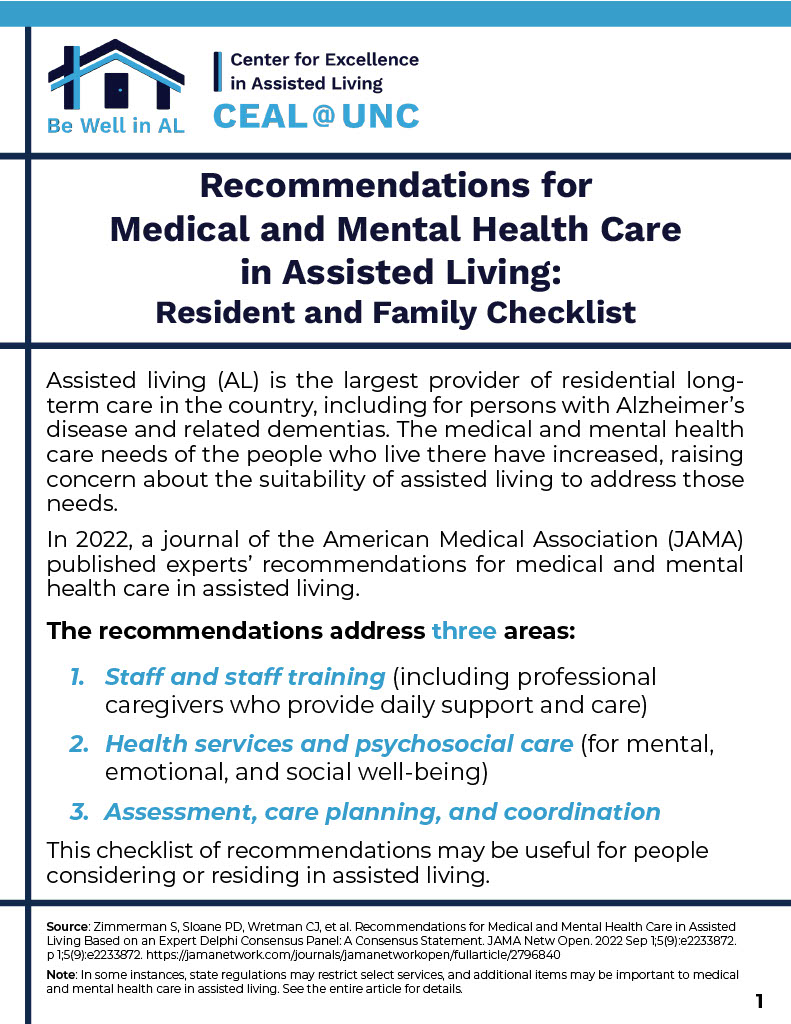
Be Well in AL Recommendations: Resident/Family Checklist
CEAL@UNC recognizes the benefit of ongoing quality improvement in assisted living, including through the implementation of consensus medical and mental health care recommendations disseminated through the Be Well in AL Initiative. This checklist, to be used by residents and their families considering or residing in assisted living, is a helpful tool to understand recommended care […]
Know the Resident: Unlocking Value and Positive Outcomes in Assisted Living Nursing
WHAT THIS MEANS FOR YOU: In this editorial, the authors emphasize that addressing social determinants of health in AL communities is crucial for improving residents’ well-being and can be accomplished in part through nurse leadership. It presents a framework to address residents’ social needs, focusing on a proactive and holistic approach to care.
Does Assisted Living Provide Assistance And Promote Living?
WHAT THIS MEANS FOR YOU: AL communities in the United States serve more than 918,000 older adults as of 2018. In this commentary, the authors examined how workforce limitations, the complexity of regulations, consumer needs, and lack of financing contribute to negative consequences for aging in place and well-being. They suggest policy changes in those four areas, such as increased staffing, boosting wages and training, encouraging uniform data reporting, and making community disclosure statements more accessible.
Bioethics in Gerontology: Developing a Typology of Ethical Issues in Assisted Living
WHAT THIS MEANS FOR YOU: A team of researchers developed a typology of the ethical conflicts that are likely to exist within AL communities. Drawing on data from a 5-year qualitative study in four ALs for validation, this typology aims to help families, staff, and residents identify and understand ethical best practices in AL communities.

Potential Actions to Advance Well-being in Assisted Living
CEAL@UNC recognizes the benefit of ongoing quality improvement in assisted living. Numerous feasible solutions have been suggested that may improve care and outcomes in assisted living, including those in this information sheet. Feel free to utilize and distribute this information sheet among your networks to advance the well-being of the people who live and work […]
A Step Toward Better Care: Understanding What Caregivers and Residents in Assisted Living Facilities Value in Health Monitoring Systems
WHAT THIS MEANS FOR YOU: Expert interviews, cognitive walkthroughs, and semi-structured interviews were conducted with 7 caregivers and 5 residents from an AL community to understand the role that health monitoring technology plays in their work and lives. Monitoring technology was viewed as a way to reduce caregivers’ workload and improve team communication. Residents were open to using the technology, but protecting their privacy and autonomy was a concern for its implementation.