End of Life

CEAL@UNC Strategic Advisor Presentations
CEAL@UNC regularly invites organizations and individuals committed to advancing well-being in assisted living through practice, research, and policy to present emerging and relevant topics to its Strategic Advisors. View Presentations

CEAL@UNC Strategic Advisor Presentations
CEAL@UNC regularly invites organizations and individuals committed to advancing well-being in assisted living through practice, research, and policy to present emerging and relevant topics to its Strategic Advisors. View Presentations
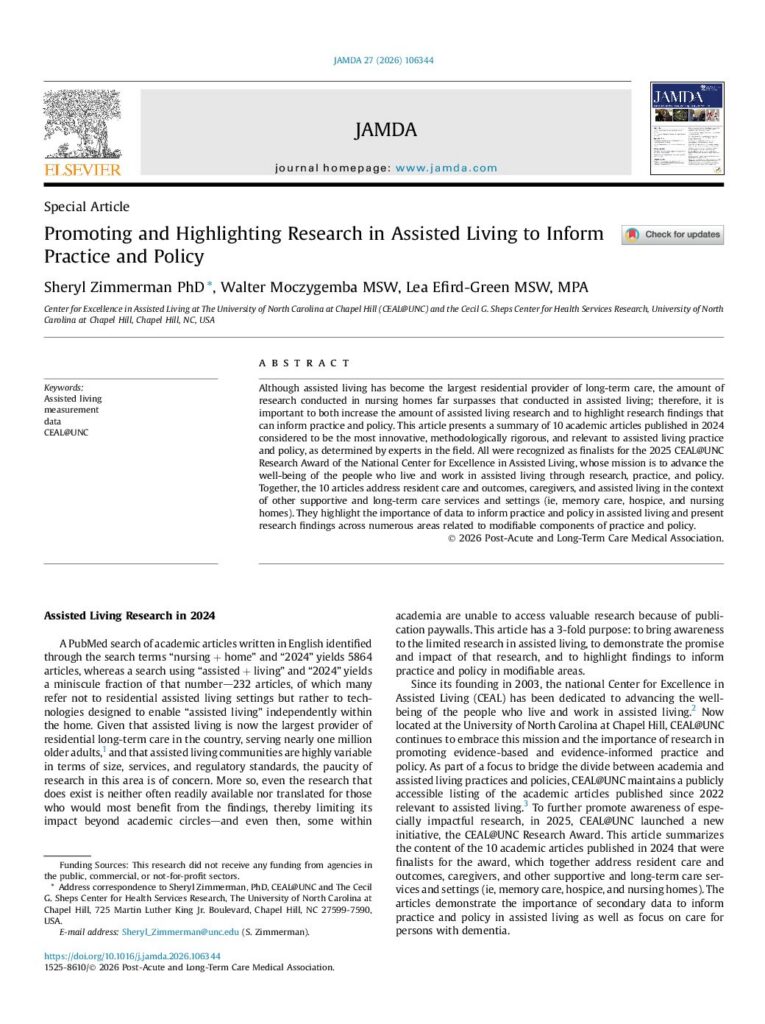
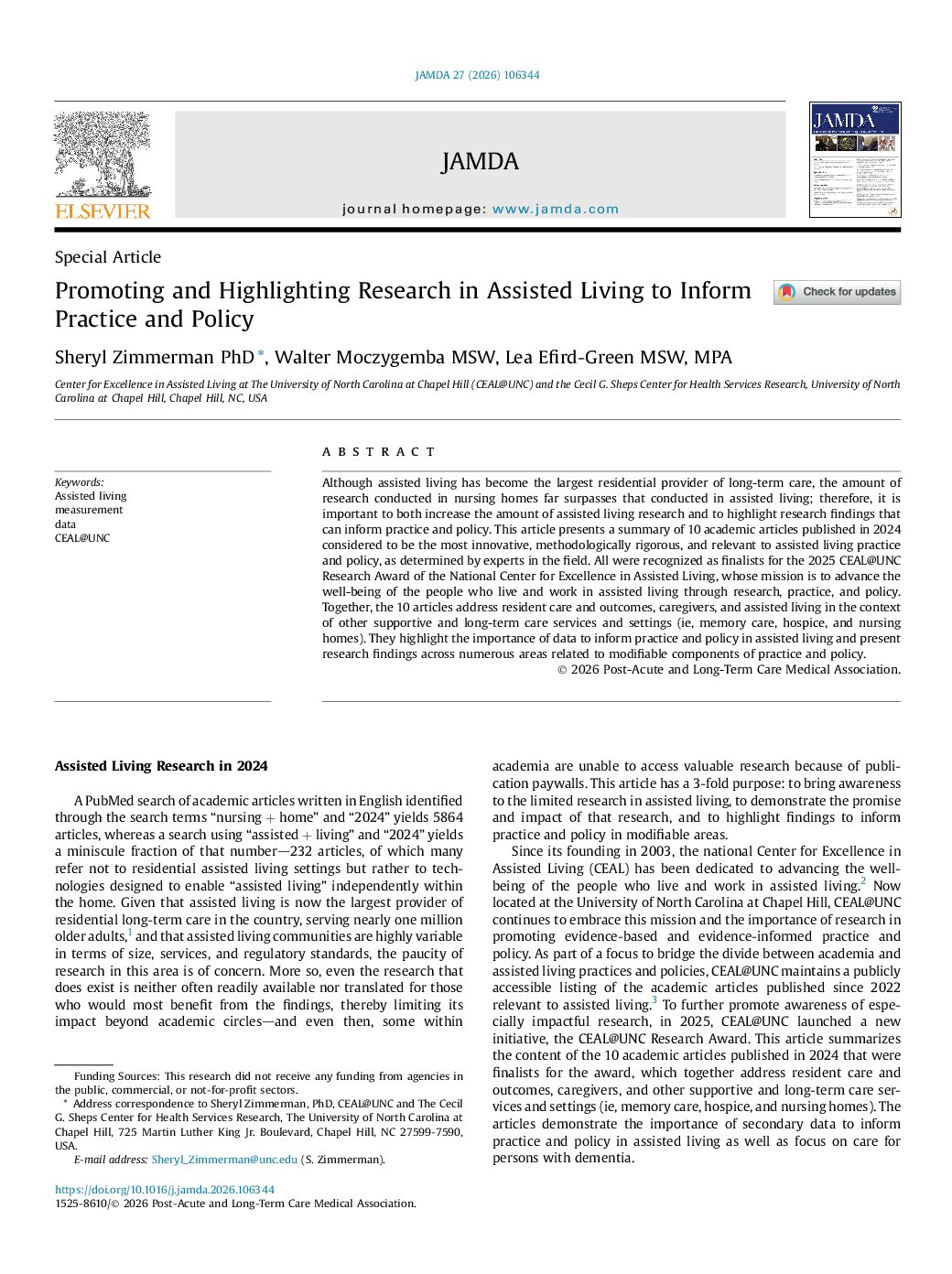
2025 CEAL@UNC Research Award Summary
End-of-Life Outcomes and Staff Visits for Hospice Recipients Residing in Assisted Living
This study used 2018 to 2019 Medicare claims data from over 42,000 AL residents to examine whether hospice staff visits were associated with end-of-life transitions, place of death, and discharges, and whether state AL regulations influence these outcomes. More frequent visits were associated with less end-of-life transitions, discharges, and increased likelihood of dying in place. Regulations requiring on-site staffing and medication delegation were also associated with fewer transitions and increased dying in place, highlighting the role that both organizational and regulatory policies in shaping end-of-life outcomes.
End-of-Life Outcomes and Staff Visits for Hospice Recipients Residing in Assisted Living
This study used 2018 to 2019 Medicare claims data from over 42,000 AL residents to examine whether hospice staff visits were associated with end-of-life transitions, place of death, and discharges, and whether state AL regulations influence these outcomes. More frequent visits were associated with less end-of-life transitions, discharges, and increased likelihood of dying in place. Regulations requiring on-site staffing and medication delegation were also associated with fewer transitions and increased dying in place, highlighting the role that both organizational and regulatory policies in shaping end-of-life outcomes.
Primary Palliative Care in Assisted Living and Residential Care: A Metasynthesis
This metasynthesis of 88 qualitative studies examined the provision of palliative care in residential care settings, including challenges and opportunities of providing care in these settings. Resulting themes included addressing physical symptoms, psychological distress, social isolation, and spiritual needs among residents with serious illness and highlight the important role of palliative care in improving quality of life care continuity of residents.
Primary Palliative Care in Assisted Living and Residential Care: A Metasynthesis
This metasynthesis of 88 qualitative studies examined the provision of palliative care in residential care settings, including challenges and opportunities of providing care in these settings. Resulting themes included addressing physical symptoms, psychological distress, social isolation, and spiritual needs among residents with serious illness and highlight the important role of palliative care in improving quality of life care continuity of residents.
Hospice Visits and Perceived Hospice Quality Among Assisted Living Residents
This cohort study used 2018-2019 Medicare Claims data from over 50,000 AL residents who received hospice care to evaluate the quality of that care. Using the Consumer Assessment of Healthcare Providers and Systems Hospice Survey, the average rating was 81 (out of 100), with factors such as increased clinical and non-clinical staff visits, family ratings of services, and feeling respected leading to higher scores and improved feelings of emotional support in residents and their families.
Hospice Visits and Perceived Hospice Quality Among Assisted Living Residents
This cohort study used 2018-2019 Medicare Claims data from over 50,000 AL residents who received hospice care to evaluate the quality of that care. Using the Consumer Assessment of Healthcare Providers and Systems Hospice Survey, the average rating was 81 (out of 100), with factors such as increased clinical and non-clinical staff visits, family ratings of services, and feeling respected leading to higher scores and improved feelings of emotional support in residents and their families.
Medical Care Provider Involvement in Ontario Assisted Living Homes: A Descriptive Cross-Sectional Survey Analysis
WHAT THIS MEANS FOR YOU: This cross-sectional Canadian study examined 88 AL communities' survey responses to assess medical care provider involvement. A total of 54 AL communities had an established medical care provider, and doctors cared for more than 50 patients in 36% of homes and 46% visited homes weekly. Almost two-thirds of communities had nurses accompany physicians on rounds, and two-thirds provided residents with palliative care. Residents in homes with medical care providers were 76% less likely to seek care from a physician in the community.
Medical Care Provider Involvement in Ontario Assisted Living Homes: A Descriptive Cross-Sectional Survey Analysis
WHAT THIS MEANS FOR YOU: This cross-sectional Canadian study examined 88 AL communities’ survey responses to assess medical care provider involvement. A total of 54 AL communities had an established medical care provider, and doctors cared for more than 50 patients in 36% of homes and 46% visited homes weekly. Almost two-thirds of communities had nurses accompany physicians on rounds, and two-thirds provided residents with palliative care. Residents in homes with medical care providers were 76% less likely to seek care from a physician in the community.
Variation in Hospice Aide Care by Residential Setting
WHAT THIS MEANS FOR YOU: This longitudinal cohort study examined data from 1,915 Medicare beneficiaries who died between 2010-2019 and had hospice claims in different residential settings to compare hospice aide use. Hospice aide visits were least common in community settings, followed by NHs and AL communities. However, analyzed factors associated with hospice aide visits were similar among settings, meaning that further research is needed to understand how to tailor hospice care appropriately for different settings.
Variation in Hospice Aide Care by Residential Setting
WHAT THIS MEANS FOR YOU: This longitudinal cohort study examined data from 1,915 Medicare beneficiaries who died between 2010-2019 and had hospice claims in different residential settings to compare hospice aide use. Hospice aide visits were least common in community settings, followed by NHs and AL communities. However, analyzed factors associated with hospice aide visits were similar among settings, meaning that further research is needed to understand how to tailor hospice care appropriately for different settings.
Do End-of-Life Outcomes Differ by Assisted Living Memory-Care Designation?
WHAT THIS MEANS FOR YOU: An analysis of 15,152 Medicare beneficiaries with ADRD examined end-of-life outcomes (mortality, hospice use, and number of days receiving hospice in the last month of life) for residents who moved to a large (25+ bed) AL between 2016 and 2018. Residents living in memory care units had a statistically significantly higher rate of mortality, higher hospice use, and more days spent receiving hospice in the last month of life than residents in general AL units.
Do End-of-Life Outcomes Differ by Assisted Living Memory-Care Designation?
WHAT THIS MEANS FOR YOU: An analysis of 15,152 Medicare beneficiaries with ADRD examined end-of-life outcomes (mortality, hospice use, and number of days receiving hospice in the last month of life) for residents who moved to a large (25+ bed) AL between 2016 and 2018. Residents living in memory care units had a statistically significantly higher rate of mortality, higher hospice use, and more days spent receiving hospice in the last month of life than residents in general AL units.
Hospice Providers Serving Assisted Living Residents: Association of Higher Volume with Lower Quality
WHAT THIS MEANS FOR YOU: Using Medicare Compare and claims data for over 2800 hospice providers, this analysis found that hospices with higher AL patient volume (i.e., a higher share of their annual patient days were from AL residents) had lower quality ratings from family caregivers in key areas such as pain management, breathing help, emotional support, communication, and family training, even when controlling for profit status and daily patient census. This result indicates that hospice providers who more frequently serve AL resident patients are on average of lower quality, and more research to understand this relationship is recommended.
Hospice Providers Serving Assisted Living Residents: Association of Higher Volume with Lower Quality
WHAT THIS MEANS FOR YOU: Using Medicare Compare and claims data for over 2800 hospice providers, this analysis found that hospices with higher AL patient volume (i.e., a higher share of their annual patient days were from AL residents) had lower quality ratings from family caregivers in key areas such as pain management, breathing help, emotional support, communication, and family training, even when controlling for profit status and daily patient census. This result indicates that hospice providers who more frequently serve AL resident patients are on average of lower quality, and more research to understand this relationship is recommended.
Resident and Caregiver Dyads Talk About Death and Dying in Assisted Living: A Typology of Communication Behaviors
WHAT THIS MEANS FOR YOU: Interviews and fieldnotes from 15 resident-family caregiver dyads in 3 Atlanta AL communities found that conversations about death and dying were conducted in four patterns: open discussions (both partners were talking with each other about death), blocked conversations (one partner wanted to talk about death, but the other did not), avoidance due to assumptions (each partner perceived that the other did not want to talk about death), and inability to engage in conversations due to cognitive decline or strained relationships. While 60% of residents wanted to talk about end-of-life, caregivers often avoided it.
Resident and Caregiver Dyads Talk About Death and Dying in Assisted Living: A Typology of Communication Behaviors
WHAT THIS MEANS FOR YOU: Interviews and fieldnotes from 15 resident-family caregiver dyads in 3 Atlanta AL communities found that conversations about death and dying were conducted in four patterns: open discussions (both partners were talking with each other about death), blocked conversations (one partner wanted to talk about death, but the other did not), avoidance due to assumptions (each partner perceived that the other did not want to talk about death), and inability to engage in conversations due to cognitive decline or strained relationships. While 60% of residents wanted to talk about end-of-life, caregivers often avoided it.
Characteristics and End-of-Life Care Pathways of Decedents From a National Cohort of Assisted Living Residents
WHAT THIS MEANS FOR YOU: Medicare data from 2017 to 2020 for nearly 270,000 individuals from larger AL communities (25+ beds) found that about 35% of residents died during the study period, most often those 85 or older or with dementia. Most residents stayed in assisted living until their last year of life, but almost 20% left before their last month of life. Among those who lived in the community 30 days before death, nearly half died at the community without any healthcare transition, while over 13% had 3 or more healthcare transfers before death. Due to the prevalence of residents dying while in residence in assisted living, end-of-life practices and policies should be evaluated.
Characteristics and End-of-Life Care Pathways of Decedents From a National Cohort of Assisted Living Residents
WHAT THIS MEANS FOR YOU: Medicare data from 2017 to 2020 for nearly 270,000 individuals from larger AL communities (25+ beds) found that about 35% of residents died during the study period, most often those 85 or older or with dementia. Most residents stayed in assisted living until their last year of life, but almost 20% left before their last month of life. Among those who lived in the community 30 days before death, nearly half died at the community without any healthcare transition, while over 13% had 3 or more healthcare transfers before death. Due to the prevalence of residents dying while in residence in assisted living, end-of-life practices and policies should be evaluated.
Turning It Over to God: African American Assisted Living Residents’ End-of-Life Preferences and Advance Care Planning
WHAT THIS MEANS FOR YOU: A qualitative study in a 100-bed assisted living community catering to African American residents found that a shared belief that God was ultimately in control related to end-of-life and advance care planning preferences, although this relationship was influenced by other individual-level factors like age, pain, function, health literacy, and past experiences with healthcare.
Turning It Over to God: African American Assisted Living Residents’ End-of-Life Preferences and Advance Care Planning
WHAT THIS MEANS FOR YOU: A qualitative study in a 100-bed assisted living community catering to African American residents found that a shared belief that God was ultimately in control related to end-of-life and advance care planning preferences, although this relationship was influenced by other individual-level factors like age, pain, function, health literacy, and past experiences with healthcare.
State Regulations and Assisted Living Residents’ Potentially Burdensome Transitions at the End of Life
WHAT THIS MEANS FOR YOU: The study examined potentially burdensome end-of-life transitions (e.g., repeated hospitalizations) in relation to state regulations, using Medicare claims data for over 129,000 assisted living residents in communities with 25 or more beds between 2017-2019. There were no associations between transitions and regulations about third-party services or staffing, and small associations between transitions and medication management regulations. These inconclusive results indicate that more research is needed to understand the wide variety of end-of-life outcomes experienced by assisted living residents.
State Regulations and Assisted Living Residents’ Potentially Burdensome Transitions at the End of Life
WHAT THIS MEANS FOR YOU: The study examined potentially burdensome end-of-life transitions (e.g., repeated hospitalizations) in relation to state regulations, using Medicare claims data for over 129,000 assisted living residents in communities with 25 or more beds between 2017-2019. There were no associations between transitions and regulations about third-party services or staffing, and small associations between transitions and medication management regulations. These inconclusive results indicate that more research is needed to understand the wide variety of end-of-life outcomes experienced by assisted living residents.
End-of-Life Care Transitions in Assisted Living: Associations With State Staffing and Training Regulations
WHAT THIS MEANS FOR YOU: This study examined associations between end-of-life care transitions (meaning stays in hospitals and nursing homes in either the 7 or 30 days before death in this study) and state staffing and training requirements for nearly 114,000 Medicare beneficiaries who died in an assisted living community in 2018-2019. A higher proportion of transitions was associated with stricter regulations about licensed and direct care worker staffing, whereas a lower proportion was associated with more specific regulations about direct care worker training. Therefore, policymakers and practitioners may want to implement regulations that make staff training requirements more specific to better address end-of-life care.
End-of-Life Care Transitions in Assisted Living: Associations With State Staffing and Training Regulations
WHAT THIS MEANS FOR YOU: This study examined associations between end-of-life care transitions (meaning stays in hospitals and nursing homes in either the 7 or 30 days before death in this study) and state staffing and training requirements for nearly 114,000 Medicare beneficiaries who died in an assisted living community in 2018-2019. A higher proportion of transitions was associated with stricter regulations about licensed and direct care worker staffing, whereas a lower proportion was associated with more specific regulations about direct care worker training. Therefore, policymakers and practitioners may want to implement regulations that make staff training requirements more specific to better address end-of-life care.
“You Gotta Have Your Cry”: Administrator and Direct Care Worker Experiences of Death in Assisted Living
WHAT THIS MEANS FOR YOU: Qualitative data from 27 administrators and 38 direct care workers in 7 assisted living communities found that when residents died, staff members balanced their personal feelings about death and their work role in a process called “managing the normalization of death” with varying levels of perceived success. Additional resources and training about managing resident death, including improved collaboration with hospice services and clearer end-of-life care policies, might be helpful for staff.
“You Gotta Have Your Cry”: Administrator and Direct Care Worker Experiences of Death in Assisted Living
WHAT THIS MEANS FOR YOU: Qualitative data from 27 administrators and 38 direct care workers in 7 assisted living communities found that when residents died, staff members balanced their personal feelings about death and their work role in a process called “managing the normalization of death” with varying levels of perceived success. Additional resources and training about managing resident death, including improved collaboration with hospice services and clearer end-of-life care policies, might be helpful for staff.
Association between State Regulations Supportive of Third-Party Services and Likelihood of Assisted Living Residents in the US Dying in Place
WHAT THIS MEANS FOR YOU: Medicare data from nearly 170,000 residents from over 8,000 assisted communities with more than 25 beds who died between 2017 and 2019 indicated that in states with regulations supportive of third-party hospice services, residents were significantly more likely to die in assisted living than in a hospital or nursing home.
Association between State Regulations Supportive of Third-Party Services and Likelihood of Assisted Living Residents in the US Dying in Place
WHAT THIS MEANS FOR YOU: Medicare data from nearly 170,000 residents from over 8,000 assisted communities with more than 25 beds who died between 2017 and 2019 indicated that in states with regulations supportive of third-party hospice services, residents were significantly more likely to die in assisted living than in a hospital or nursing home.
Successful Aging in Assisted Living: The Importance of Near Visual Acuity
Successful aging among independent community-dwelling older adults and those in residential settings is paramount to aging in place. The purpose of the current study was to explore how sensory, cognitive, and functional impairments affect successful aging in assisted living (AL) settings. Vision compromise was noted for near visual acuity (NVA) (14.3%) and distance visual acuity […]
Successful Aging in Assisted Living: The Importance of Near Visual Acuity
Successful aging among independent community-dwelling older adults and those in residential settings is paramount to aging in place. The purpose of the current study was to explore how sensory, cognitive, and functional impairments affect successful aging in assisted living (AL) settings. Vision compromise was noted for near visual acuity (NVA) (14.3%) and distance visual acuity […]
State Regulations and Hospice Utilization in Assisted Living during the Last Month of Life
WHAT THIS MEANS FOR YOU: Medicare data from 23,000 residents in more than 6,000 assisted living communities found that 56% received hospice care during their last month of life. Communities in states with more supportive hospice regulations had significantly more hospice use, especially a more intense type called continuous home care (CHC). Modifications to state regulations to be more supportive of hospice care/CHC might increase the number of residents who use hospice, which might improve quality of life in the days immediately preceding death.
State Regulations and Hospice Utilization in Assisted Living during the Last Month of Life
WHAT THIS MEANS FOR YOU: Medicare data from 23,000 residents in more than 6,000 assisted living communities found that 56% received hospice care during their last month of life. Communities in states with more supportive hospice regulations had significantly more hospice use, especially a more intense type called continuous home care (CHC). Modifications to state regulations to be more supportive of hospice care/CHC might increase the number of residents who use hospice, which might improve quality of life in the days immediately preceding death.
End-Of-Life Care In Assisted Living Communities: Race And Ethnicity, Dual Enrollment Status, And State Regulations
WHAT THIS MEANS FOR YOU: This study examined end-of-life care in assisted living – specifically whether residents died in the community or elsewhere and received hospice care -- and whether these were associated with select factors. Among 100,783 Medicare beneficiaries who died in 16,560 communities during 2018–2019, nearly 60% died in their community, with 84% receiving hospice care. Communities with more Medicare-Medicaid enrollment had more residents dying in the community, and white residents were more likely than Black ones to use hospice care. In states with less strict assisted living regulations (e.g., for dementia care, admission/retention, and staffing/training), residents were more likely to die outside of the community (e.g., in a hospital or nursing home).
End-Of-Life Care In Assisted Living Communities: Race And Ethnicity, Dual Enrollment Status, And State Regulations
WHAT THIS MEANS FOR YOU: This study examined end-of-life care in assisted living – specifically whether residents died in the community or elsewhere and received hospice care — and whether these were associated with select factors. Among 100,783 Medicare beneficiaries who died in 16,560 communities during 2018–2019, nearly 60% died in their community, with 84% receiving hospice care. Communities with more Medicare-Medicaid enrollment had more residents dying in the community, and white residents were more likely than Black ones to use hospice care. In states with less strict assisted living regulations (e.g., for dementia care, admission/retention, and staffing/training), residents were more likely to die outside of the community (e.g., in a hospital or nursing home).
Ethics of Health Information Sharing and Social Relationships at End of Life in Assisted Living
WHAT THIS MEANS FOR YOU: This qualitative study of observation and 61 interviews with assisted living residents, family members, staff, and external care workers in one large community in Atlanta, found that while sharing health information could strengthen social bonds among residents, there were concerns about privacy; for example, when inappropriate public exchanges occurred, they hindered social relationship building. Barriers to communicating health information contributed to resident isolation, but negotiating privacy boundaries to share such information may promote resident wellbeing.
Ethics of Health Information Sharing and Social Relationships at End of Life in Assisted Living
WHAT THIS MEANS FOR YOU: This qualitative study of observation and 61 interviews with assisted living residents, family members, staff, and external care workers in one large community in Atlanta, found that while sharing health information could strengthen social bonds among residents, there were concerns about privacy; for example, when inappropriate public exchanges occurred, they hindered social relationship building. Barriers to communicating health information contributed to resident isolation, but negotiating privacy boundaries to share such information may promote resident wellbeing.
“You Lose Some Good Friends”: Death and Grief in Assisted Living
WHAT THIS MEANS FOR YOU: In a qualitative study including interviews with 18 residents in 21 assisted living communities, as well as reviews of community documents and observational field notes, residents reported that staff communication and community-level memorials following residents’ death were not consistent with a “family-like” atmosphere, and residents’ grief took many forms.
“You Lose Some Good Friends”: Death and Grief in Assisted Living
WHAT THIS MEANS FOR YOU: In a qualitative study including interviews with 18 residents in 21 assisted living communities, as well as reviews of community documents and observational field notes, residents reported that staff communication and community-level memorials following residents’ death were not consistent with a “family-like” atmosphere, and residents’ grief took many forms.
Assisted Living Administrators’ Approaches to Advance Care Planning
WHAT THIS MEANS FOR YOU: Interviews with 27 AL administrators revealed different approaches to advanced care planning (ACP). They all acknowledged the importance of ACP and often discussed topics like “do-not-resuscitate” orders when new residents arrived. Challenges included insufficient ACP training for staff and administrators and some reluctance from residents and families to discuss ACP. Most communities lacked a systematic, structured ACP approach.

Assisted Living Administrators’ Approaches to Advance Care Planning
WHAT THIS MEANS FOR YOU: Interviews with 27 AL administrators revealed different approaches to advanced care planning (ACP). They all acknowledged the importance of ACP and often discussed topics like “do-not-resuscitate” orders when new residents arrived. Challenges included insufficient ACP training for staff and administrators and some reluctance from residents and families to discuss ACP. Most communities lacked a systematic, structured ACP approach.
State Variation in Potentially Burdensome Transitions among Assisted Living Residents at the End of Life
WHAT THIS MEANS FOR YOU: There are significant differences in the quality of end-of-life care in AL. Research on 37,668 deceased Medicare beneficiaries who lived in AL found that 1 in 5 experienced challenging transitions including frequent hospitalizations before their death. Burdensome transitions, especially in the last three days of life, varied widely among states, which may be associated with state-level regulations.
State Variation in Potentially Burdensome Transitions among Assisted Living Residents at the End of Life
WHAT THIS MEANS FOR YOU: There are significant differences in the quality of end-of-life care in AL. Research on 37,668 deceased Medicare beneficiaries who lived in AL found that 1 in 5 experienced challenging transitions including frequent hospitalizations before their death. Burdensome transitions, especially in the last three days of life, varied widely among states, which may be associated with state-level regulations.