• Skip to primary navigation
  • Skip to main content
  • Skip to footer
Center for Excellence in Assisted Living

Center for Excellence in Assisted Living CEAL@UNC

Advancing the well-being of the people who live and work in assisted living through research, practice, and policy.

  • Home
  • About
    • Assisted Living and CEAL@UNC
    • CEAL@UNC Vision, Mission, and Principles
    • Leadership
      • Faculty and Staff
      • Advisory Board
      • Strategic Advisors
  • Core Areas and Projects
    • Consumer Core
    • Practice Core
    • Policy Core
    • Research Core
      • Affiliates
      • Assisted Living Research in Progress
      • CEAL@UNC Research Award
      • Expert Registry
  • Resources
    • CEAL@UNC Resources and Publications
    • CEAL@UNC Affiliate Resources
    • Assisted Living Research
  • News & Events

Search Center for Excellence in Assisted Living

Staff/Staffing

Measurement of Quality in Assisted Living in the United States of America: A Scoping Review

Jan 1, 2025
WHAT THIS MEANS FOR YOU: This scoping review examined 49 peer-reviewed and 45 gray literature articles from 2009-2019 to assess approaches to, and indicators of, quality in assisted living. After thematic analysis, nine domains emerged, with resident qualiy of life and satisfaction being the most prioritized. These nine domains may help inform future standardized quality measurement for AL settings.
Measurement of Quality in Assisted Living in the United States of America: A Scoping Review

January 1, 2025 by Lea Efird-Green

WHAT THIS MEANS FOR YOU: This scoping review examined 49 peer-reviewed and 45 gray literature articles from 2009-2019 to assess approaches to, and indicators of, quality in assisted living. After thematic analysis, nine domains emerged, with resident qualiy of life and satisfaction being the most prioritized. These nine domains may help inform future standardized quality measurement for AL settings.
Stress-Related Coping and its Relationship to Well-Being in Nursing Assistants and Personal Care Aides in Nursing Homes and Assisted Living

Dec 1, 2024
WHAT THIS MEANS FOR YOU: This cross-sectional study used questionnaire data from 391 professional caregivers from 13 facilities in 3 states to examine coping and its relationship with demographic characteristics of direct caregivers in long-term care. Older staff used adaptive psychological strategies more than younger staff, and traditionally minoritized staff used more adaptive and less maladaptive psychological strategies than white staff. Using avoidance and maladaptive coping strategies was associated with depressive and anxiety symptoms, as well as burnout. Professional caregivers use a variety of coping mechanisms, and training on adaptive coping could improve outcomes for this population.

Stress-Related Coping and its Relationship to Well-Being in Nursing Assistants and Personal Care Aides in Nursing Homes and Assisted Living

December 1, 2024 by Lea Efird-Green

WHAT THIS MEANS FOR YOU: This cross-sectional study used questionnaire data from 391 professional caregivers from 13 facilities in 3 states to examine coping and its relationship with demographic characteristics of direct caregivers in long-term care. Older staff used adaptive psychological strategies more than younger staff, and traditionally minoritized staff used more adaptive and less maladaptive psychological strategies than white staff. Using avoidance and maladaptive coping strategies was associated with depressive and anxiety symptoms, as well as burnout. Professional caregivers use a variety of coping mechanisms, and training on adaptive coping could improve outcomes for this population.

A New Measure of Professional Caregiver Coping in Long-Term Care: The LTC COPE

Dec 1, 2024
WHAT THIS MEANS FOR YOU: This study developed a new measure for how professional caregivers cope with stress. Data was collected from 391 caregivers in 13 long-term care communities across 3 states using the Long-Term Care Cope instrument. Coping strategies were found to be highly individual with many reporting using multiple strategies. Further testing of the scale is needed to understand and narrow the items in the subcomponents.

A New Measure of Professional Caregiver Coping in Long-Term Care: The LTC COPE

December 1, 2024 by Lea Efird-Green

WHAT THIS MEANS FOR YOU: This study developed a new measure for how professional caregivers cope with stress. Data was collected from 391 caregivers in 13 long-term care communities across 3 states using the Long-Term Care Cope instrument. Coping strategies were found to be highly individual with many reporting using multiple strategies. Further testing of the scale is needed to understand and narrow the items in the subcomponents.

The Role of Workday Characteristics on Perceived Stress and Time Pressure among Nurses in Finnish Long-Term Care – A Cross-Sectional Study

Dec 1, 2024
WHAT THIS MEANS FOR YOU: This study examined 503 nurses from 44 AL communities in Finland to examine the relationship between workday characteristics and perceived stress and time pressure. More care task events, clients with greater needs, reduced break times, and disruptions during the day were related to stress and time pressure for staff. Findings indicate that dividing workload evenly among nursing teams can help reduce stress and time pressure.

The Role of Workday Characteristics on Perceived Stress and Time Pressure among Nurses in Finnish Long-Term Care – A Cross-Sectional Study

December 1, 2024 by Lea Efird-Green

WHAT THIS MEANS FOR YOU: This study examined 503 nurses from 44 AL communities in Finland to examine the relationship between workday characteristics and perceived stress and time pressure. More care task events, clients with greater needs, reduced break times, and disruptions during the day were related to stress and time pressure for staff. Findings indicate that dividing workload evenly among nursing teams can help reduce stress and time pressure.

Staffing Patterns in Nursing Homes, Assisted Living Communities, and Memory Care Units: Variation Across Shifts

Nov 1, 2024
WHAT THIS MEANS FOR YOU: This study used observational data from 678 nursing staff at NHs and 432 nursing staff at AL communities in Ohio to assess their direct care nursing staffing patterns. Both NHs and AL communities had better daytime staffing ratios than overnights, although NH staffing ratios were superior to those in AL communities. In AL and NH memory care units, staffing patterns were similar. As acuity increases in AL communities, more nursing staff will likely be required, especially on overnight shifts.

Staffing Patterns in Nursing Homes, Assisted Living Communities, and Memory Care Units: Variation Across Shifts

November 1, 2024 by Lea Efird-Green

WHAT THIS MEANS FOR YOU: This study used observational data from 678 nursing staff at NHs and 432 nursing staff at AL communities in Ohio to assess their direct care nursing staffing patterns. Both NHs and AL communities had better daytime staffing ratios than overnights, although NH staffing ratios were superior to those in AL communities. In AL and NH memory care units, staffing patterns were similar. As acuity increases in AL communities, more nursing staff will likely be required, especially on overnight shifts.

Health of the Pandemic: Dementia Paid Staff and Unpaid Caregiver Workforce in Congregate Care and Community Settings

Oct 1, 2024
WHAT THIS MEANS FOR YOU: This study used questionnaires to capture the experiences of 182 paid staff and 148 unpaid caregivers of people living with dementia living in the community and long-term care settings across the US during theCOVID-19 pandemic. Paid staff were more likely to have been exposed, tested, hospitalized, or been ill with COVID-19 and had more medical and mental health services impacts than unpaid caregivers. Unpaid caregivers showed higher rates of depressive symptom severity and scored lower for hope than paid staff, showing disparate negative impacts from COVID-related stressors.

Health of the Pandemic: Dementia Paid Staff and Unpaid Caregiver Workforce in Congregate Care and Community Settings

October 1, 2024 by Lea Efird-Green

WHAT THIS MEANS FOR YOU: This study used questionnaires to capture the experiences of 182 paid staff and 148 unpaid caregivers of people living with dementia living in the community and long-term care settings across the US during theCOVID-19 pandemic. Paid staff were more likely to have been exposed, tested, hospitalized, or been ill with COVID-19 and had more medical and mental health services impacts than unpaid caregivers. Unpaid caregivers showed higher rates of depressive symptom severity and scored lower for hope than paid staff, showing disparate negative impacts from COVID-related stressors.

An Initial Exploration into Job Satisfaction Among Long-Term Care Administrators and State Tested Nursing Assistants in Ohio

Oct 1, 2024
WHAT THIS MEANS FOR YOU: This pilot study used 2 surveys to examine 28 licensed nursing home administrators' and 17 state-tested nursing assistants' opinions on job satisfaction, future plans, potential changes, and how to reduce turnover in Ohio. Working with residents and families contributed to satisfaction, but wages were a concern, and many employees face burnout. These factors should be addressed in order to address turnover and staffing shortages in long-term care settings.

An Initial Exploration into Job Satisfaction Among Long-Term Care Administrators and State Tested Nursing Assistants in Ohio

October 1, 2024 by Lea Efird-Green

WHAT THIS MEANS FOR YOU: This pilot study used 2 surveys to examine 28 licensed nursing home administrators’ and 17 state-tested nursing assistants’ opinions on job satisfaction, future plans, potential changes, and how to reduce turnover in Ohio. Working with residents and families contributed to satisfaction, but wages were a concern, and many employees face burnout. These factors should be addressed in order to address turnover and staffing shortages in long-term care settings.

Reliability and Validity Testing of the Modified Quality of Interaction Scale

Sep 1, 2024
WHAT THIS MEANS FOR YOU: This study used observational data from 152 staff-resident interactions in 4 AL communities to test the reliability and validity of the Modified Quality of Interaction Scale. There was some evidence for both reliability and validity, as resident engagement was significantly associated with positive social and care interactions, but reliability and validity were not comprehensively supported in this setting.

Reliability and Validity Testing of the Modified Quality of Interaction Scale

September 1, 2024 by Lea Efird-Green

WHAT THIS MEANS FOR YOU: This study used observational data from 152 staff-resident interactions in 4 AL communities to test the reliability and validity of the Modified Quality of Interaction Scale. There was some evidence for both reliability and validity, as resident engagement was significantly associated with positive social and care interactions, but reliability and validity were not comprehensively supported in this setting.

Determinants of Received Care Time among Finnish Home Care Clients and Assisted Living Facility Residents: A Time-Motion Study

Sep 1, 2024
WHAT THIS MEANS FOR YOU: This cross-sectional observational study examined individual and organizational factors associated with received care time for 1477 home care clients and 1538 residents from 61 AL care units in Finland. Physical functioning associated with activities of daily living was the highest predictor of care time in both settings. In home care greater pain, unstable health, and care team autonomy were associated with more care time, whereas depressive mood and higher staffing ratios were associated in AL care units.

Determinants of Received Care Time among Finnish Home Care Clients and Assisted Living Facility Residents: A Time-Motion Study

September 1, 2024 by Lea Efird-Green

WHAT THIS MEANS FOR YOU: This cross-sectional observational study examined individual and organizational factors associated with received care time for 1477 home care clients and 1538 residents from 61 AL care units in Finland. Physical functioning associated with activities of daily living was the highest predictor of care time in both settings. In home care greater pain, unstable health, and care team autonomy were associated with more care time, whereas depressive mood and higher staffing ratios were associated in AL care units.

Nursing Staff’s Perspectives of Care Robots for Assisted Living Facilities: Systematic Literature Review

Sep 1, 2024
WHAT THIS MEANS FOR YOU: This systematic review examined the results of 15 studies about nurses' attitudes toward care robots in assisted living communities. The studies were conducted with small sample sizes, and there were concerns from nurses regarding ethics, safety, accessibility, and Overall, nurses supported care robots for assisting with physical tasks and reducing workload, but were mixed about whether they should help with social tasks.

Nursing Staff’s Perspectives of Care Robots for Assisted Living Facilities: Systematic Literature Review

September 1, 2024 by Lea Efird-Green

WHAT THIS MEANS FOR YOU: This systematic review examined the results of 15 studies about nurses’ attitudes toward care robots in assisted living communities. The studies were conducted with small sample sizes, and there were concerns from nurses regarding ethics, safety, accessibility, and Overall, nurses supported care robots for assisting with physical tasks and reducing workload, but were mixed about whether they should help with social tasks.

Impact of Antecedent and Organizational Differences on Nurse-Social Worker Collaboration in a Retirement and Assisted Living Community with Skilled Nursing Care

Aug 1, 2024
WHAT THIS MEANS FOR YOU: This qualitative thematic study of 23 workers at a Midwestern AL community explored nurses' and social workers' collaborative experiences. Contrasts arose in responding to resident complexity and peer-to-peer work, with a main difference being social workers' focus on resident self-determination and nurses' focus on resident safety. Social workers showed greater openness to working with nurses while nurses showed greater separation, which has implications for teamwork in these settings.

Impact of Antecedent and Organizational Differences on Nurse-Social Worker Collaboration in a Retirement and Assisted Living Community with Skilled Nursing Care

August 1, 2024 by Lea Efird-Green

WHAT THIS MEANS FOR YOU: This qualitative thematic study of 23 workers at a Midwestern AL community explored nurses’ and social workers’ collaborative experiences. Contrasts arose in responding to resident complexity and peer-to-peer work, with a main difference being social workers’ focus on resident self-determination and nurses’ focus on resident safety. Social workers showed greater openness to working with nurses while nurses showed greater separation, which has implications for teamwork in these settings.

The Prevalence and Benefits of Self-Compassion Among Professional Caregivers

Aug 1, 2024
WHAT THIS MEANS FOR YOU: This cross-sectional study examined the relationship between self-compassion, anxiety and depressive symptoms, and job satisfaction from 391 caregivers across 13 nursing homes and assisted living communities in 3 states. Older caregivers, those with higher education, and those who were born outside the US reported highest self-compassion, while white caregivers reported the lowest. Self-compassion was negatively associated with mental health symptoms and positively associated with job satisfaction, meaning that its use could be beneficial as one method to address workforce issues in long-term care.

The Prevalence and Benefits of Self-Compassion Among Professional Caregivers

August 1, 2024 by Lea Efird-Green

WHAT THIS MEANS FOR YOU: This cross-sectional study examined the relationship between self-compassion, anxiety and depressive symptoms, and job satisfaction from 391 caregivers across 13 nursing homes and assisted living communities in 3 states. Older caregivers, those with higher education, and those who were born outside the US reported highest self-compassion, while white caregivers reported the lowest. Self-compassion was negatively associated with mental health symptoms and positively associated with job satisfaction, meaning that its use could be beneficial as one method to address workforce issues in long-term care.

Adaptive Biking for Assisted Living Memory Care Residents and Staff: A Feasibility Study

Aug 1, 2024
WHAT THIS MEANS FOR YOU: This study paired 8 memory care residents and 7 staff members from an AL community to test a biking program as an intervention to improve health and well-being. The pairs completed eight 20-30 minute bike rides over 4 weeks. The rides gave residents and staff a chance to discuss issues around health and well-being. Qualitative results indicate further piloting of the program could be warranted given its acceptability and feasibility.

Adaptive Biking for Assisted Living Memory Care Residents and Staff: A Feasibility Study

August 1, 2024 by Lea Efird-Green

WHAT THIS MEANS FOR YOU: This study paired 8 memory care residents and 7 staff members from an AL community to test a biking program as an intervention to improve health and well-being. The pairs completed eight 20-30 minute bike rides over 4 weeks. The rides gave residents and staff a chance to discuss issues around health and well-being. Qualitative results indicate further piloting of the program could be warranted given its acceptability and feasibility.

A Cross-Sectional Study of Nurse Turnover in Residential Care Communities

Aug 1, 2024
WHAT THIS MEANS FOR YOU: This cross-sectional study examined 2018 public data of RNs and aides in residential care communities (RCCs) to examine factors related to turnover. On average, RN turnover was 72% and aide turnover was 48%. Non-profit RCCs had lower turnover and chain facilities had higher turnover. Contrary to predictions, large RCCs had lower turnover rates.

A Cross-Sectional Study of Nurse Turnover in Residential Care Communities

August 1, 2024 by Lea Efird-Green

WHAT THIS MEANS FOR YOU: This cross-sectional study examined 2018 public data of RNs and aides in residential care communities (RCCs) to examine factors related to turnover. On average, RN turnover was 72% and aide turnover was 48%. Non-profit RCCs had lower turnover and chain facilities had higher turnover. Contrary to predictions, large RCCs had lower turnover rates.

Assessing the Potential of Technology to Describe Resident and Staff Interactions in Assisted Living Facilities

Jul 1, 2024
WHAT THIS MEANS FOR YOU: This study examined 83 staff at an AL community in New York using a remote surveillance technology to assess nurse-resident interactions and improve falls prevention over 170 days. Data showed that staff visited residents an average of 20.7 times a day. As compared to traditional in-person methods, staff responded faster through the app (2.7 minutes via app vs. 3.3 minutes via in-person call requests) to urgent alerts.

Assessing the Potential of Technology to Describe Resident and Staff Interactions in Assisted Living Facilities

July 1, 2024 by Lea Efird-Green

WHAT THIS MEANS FOR YOU: This study examined 83 staff at an AL community in New York using a remote surveillance technology to assess nurse-resident interactions and improve falls prevention over 170 days. Data showed that staff visited residents an average of 20.7 times a day. As compared to traditional in-person methods, staff responded faster through the app (2.7 minutes via app vs. 3.3 minutes via in-person call requests) to urgent alerts.

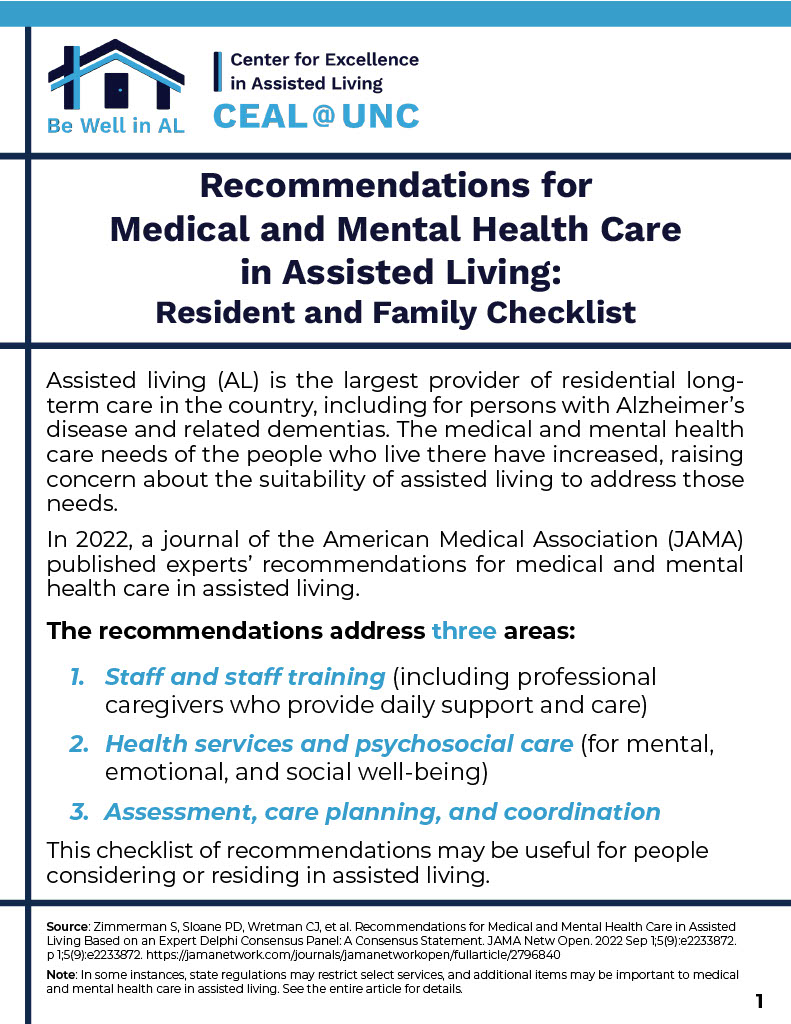
Be Well in AL Recommendations: Resident/Family Checklist

Jun 10, 2024
CEAL@UNC recognizes the benefit of ongoing quality improvement in assisted living, including through the implementation of consensus medical and mental health care recommendations disseminated through the Be Well in AL Initiative. This checklist, to be used by residents and their families considering or residing in assisted living, is a helpful tool to understand recommended care […]

Be Well in AL Recommendations: Resident/Family Checklist

June 10, 2024 by Lea Efird-Green

CEAL@UNC recognizes the benefit of ongoing quality improvement in assisted living, including through the implementation of consensus medical and mental health care recommendations disseminated through the Be Well in AL Initiative. This checklist, to be used by residents and their families considering or residing in assisted living, is a helpful tool to understand recommended care […]

Changes in Nursing Staff Levels and Injury-Related Emergency Department Visits among Assisted Living Residents with Alzheimers Disease and Related Dementias

Jun 1, 2024
WHAT THIS MEANS FOR YOU: An analysis of 2007-2015 Medicare data for over 12,000 AL residents with ADRD in 455 Ohio AL communities showed that higher levels of RN staffing hours per resident per day led to a 53% decrease in injury-related emergency department visits.

Changes in Nursing Staff Levels and Injury-Related Emergency Department Visits among Assisted Living Residents with Alzheimers Disease and Related Dementias

June 1, 2024 by Lea Efird-Green

WHAT THIS MEANS FOR YOU: An analysis of 2007-2015 Medicare data for over 12,000 AL residents with ADRD in 455 Ohio AL communities showed that higher levels of RN staffing hours per resident per day led to a 53% decrease in injury-related emergency department visits.

Does Assisted Living Provide Assistance And Promote Living?

May 1, 2024
WHAT THIS MEANS FOR YOU: AL communities in the United States serve more than 918,000 older adults as of 2018. In this commentary, the authors examined how workforce limitations, the complexity of regulations, consumer needs, and lack of financing contribute to negative consequences for aging in place and well-being. They suggest policy changes in those four areas, such as increased staffing, boosting wages and training, encouraging uniform data reporting, and making community disclosure statements more accessible.

Does Assisted Living Provide Assistance And Promote Living?

May 1, 2024 by Lea Efird-Green

WHAT THIS MEANS FOR YOU: AL communities in the United States serve more than 918,000 older adults as of 2018. In this commentary, the authors examined how workforce limitations, the complexity of regulations, consumer needs, and lack of financing contribute to negative consequences for aging in place and well-being. They suggest policy changes in those four areas, such as increased staffing, boosting wages and training, encouraging uniform data reporting, and making community disclosure statements more accessible.

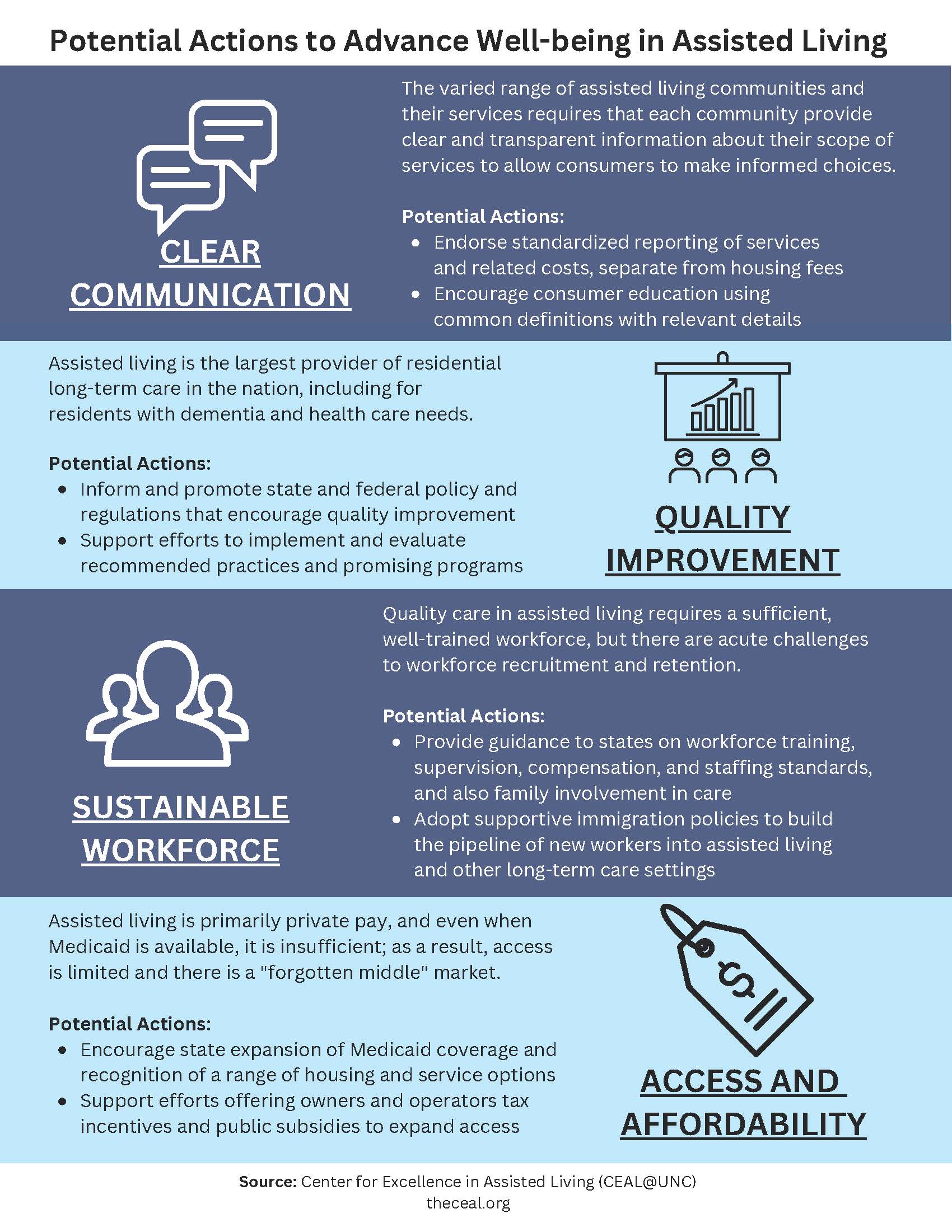
Potential Actions to Advance Well-being in Assisted Living

Apr 23, 2024
CEAL@UNC recognizes the benefit of ongoing quality improvement in assisted living. Numerous feasible solutions have been suggested that may improve care and outcomes in assisted living, including those in this information sheet. Feel free to utilize and distribute this information sheet among your networks to advance the well-being of the people who live and work […]

Potential Actions to Advance Well-being in Assisted Living

April 23, 2024 by Lea Efird-Green

CEAL@UNC recognizes the benefit of ongoing quality improvement in assisted living. Numerous feasible solutions have been suggested that may improve care and outcomes in assisted living, including those in this information sheet. Feel free to utilize and distribute this information sheet among your networks to advance the well-being of the people who live and work […]

A Step Toward Better Care: Understanding What Caregivers and Residents in Assisted Living Facilities Value in Health Monitoring Systems

Apr 1, 2024
WHAT THIS MEANS FOR YOU: Expert interviews, cognitive walkthroughs, and semi-structured interviews were conducted with 7 caregivers and 5 residents from an AL community to understand the role that health monitoring technology plays in their work and lives. Monitoring technology was viewed as a way to reduce caregivers' workload and improve team communication. Residents were open to using the technology, but protecting their privacy and autonomy was a concern for its implementation.

A Step Toward Better Care: Understanding What Caregivers and Residents in Assisted Living Facilities Value in Health Monitoring Systems

April 1, 2024 by Lea Efird-Green

WHAT THIS MEANS FOR YOU: Expert interviews, cognitive walkthroughs, and semi-structured interviews were conducted with 7 caregivers and 5 residents from an AL community to understand the role that health monitoring technology plays in their work and lives. Monitoring technology was viewed as a way to reduce caregivers’ workload and improve team communication. Residents were open to using the technology, but protecting their privacy and autonomy was a concern for its implementation.

The Impact of Assisted Living Organizational Structure and Process Characteristics on Staff Absence During COVID-19

Apr 1, 2024
WHAT THIS MEANS FOR YOU: In 129 Florida AL communities, higher staff absences due to fear of infection, sickness, or family responsibilities during the COVID-19 pandemic were statistically significantly associated with provision of memory care services; care processes (challenges hiring new staff, staff sent home to comply with COVID-19 precautions, and staff anxiety); and local COVID-19 infection rates.

The Impact of Assisted Living Organizational Structure and Process Characteristics on Staff Absence During COVID-19

April 1, 2024 by Lea Efird-Green

WHAT THIS MEANS FOR YOU: In 129 Florida AL communities, higher staff absences due to fear of infection, sickness, or family responsibilities during the COVID-19 pandemic were statistically significantly associated with provision of memory care services; care processes (challenges hiring new staff, staff sent home to comply with COVID-19 precautions, and staff anxiety); and local COVID-19 infection rates.

Perceptions of the Use of Terms of Endearment among Older Adults in an Assisted Living Facility

Apr 1, 2024
WHAT THIS MEANS FOR YOU: Elderspeak, which includes terms of endearment used by healthcare workers for older adults, was examined via interviews with 15 New York AL residents. Participants’ opinions varied; some liked the terms, some were neutral, and some thought they were disrespectful; thus, it is recommended that healthcare workers adjust their communication based on residents’ personal preferences.

Perceptions of the Use of Terms of Endearment among Older Adults in an Assisted Living Facility

April 1, 2024 by Lea Efird-Green

WHAT THIS MEANS FOR YOU: Elderspeak, which includes terms of endearment used by healthcare workers for older adults, was examined via interviews with 15 New York AL residents. Participants’ opinions varied; some liked the terms, some were neutral, and some thought they were disrespectful; thus, it is recommended that healthcare workers adjust their communication based on residents’ personal preferences.

Do-Not-Hospitalize Orders in Assisted Living Facilities: Direct Care Workers’ Perspectives

Apr 1, 2024
WHAT THIS MEANS FOR YOU: Eight participants were surveyed and interviewed to inform an intervention that would prevent direct care workers from sending residents with do-not-hospitalize orders to the hospital. Results revealed care workers were unfamiliar with do-not-hospitalize orders and had binary thinking (e.g., residents had to be sent to hospice or the hospital) on end-of-life issues. Supportive leaders in the assisted living communities that could assist direct care workers during these complex situations were found to be helpful.

Do-Not-Hospitalize Orders in Assisted Living Facilities: Direct Care Workers’ Perspectives

April 1, 2024 by Lea Efird-Green

WHAT THIS MEANS FOR YOU: Eight participants were surveyed and interviewed to inform an intervention that would prevent direct care workers from sending residents with do-not-hospitalize orders to the hospital. Results revealed care workers were unfamiliar with do-not-hospitalize orders and had binary thinking (e.g., residents had to be sent to hospice or the hospital) on end-of-life issues. Supportive leaders in the assisted living communities that could assist direct care workers during these complex situations were found to be helpful.

Using Assisted Living Communities to Enhance Nursing Student Attitudes Toward Older Adults

Feb 1, 2024
WHAT THIS MEANS FOR YOU: A total of 70 nursing students at one Western US university participated in a clinical project in which they interviewed an AL resident and provided an educational session to residents at an AL community. Students, AL communities, and instructors all reported positive experiences in this clinical experience, and students reported more positive attitudes towards older adults.

Using Assisted Living Communities to Enhance Nursing Student Attitudes Toward Older Adults

February 1, 2024 by Lea Efird-Green

WHAT THIS MEANS FOR YOU: A total of 70 nursing students at one Western US university participated in a clinical project in which they interviewed an AL resident and provided an educational session to residents at an AL community. Students, AL communities, and instructors all reported positive experiences in this clinical experience, and students reported more positive attitudes towards older adults.

  • « Go to Previous Page
  • Page 1
  • Page 2
  • Page 3
  • Go to Next Page »

Footer

Contact

CEAL@UNC
325 Pittsboro Street
Chapel Hill, NC 27599-3550
Email: CEAL@office.unc.edu
UNC School of Social Work Logo

Connect

  • Facebook
  • LinkedIn

Featured Resource

Copyright © 2026 · Center for Excellence in Assisted Living · All Rights Reserved · Website by Tomatillo Design
