WHAT THIS MEANS FOR YOU: This study of 71 residents with dementia in 5 AL communities assessed the relationship between engagement in meaningful activities and symptoms of dementia. Perceived engagement in meaningful activities was significantly associated with decreased agitation, but not apathy, depression, or irritability.
Cognitive/Dementia
Clinical and Sociodemographic Characteristics of New Residents of Assisted Living: A Nested Case-Control Study
WHAT THIS MEANS FOR YOU: This nested case-control study in Ontario examined differences between community-dwelling and new AL residents to understand transitions to AL communitiess. New residents had higher rates of diagnosed dementia, mood disorders, cardiac arrhythmias, mild cognitive impairment, and falls than community-dwelling peers. New AL residents also had lower odds of having a spousal caregiver than a child caregiver. However, these residents also had higher rates of participation in activities of interest in the last seven days.
Health of the Pandemic: Dementia Paid Staff and Unpaid Caregiver Workforce in Congregate Care and Community Settings
WHAT THIS MEANS FOR YOU: This study used questionnaires to capture the experiences of 182 paid staff and 148 unpaid caregivers of people living with dementia living in the community and long-term care settings across the US during theCOVID-19 pandemic. Paid staff were more likely to have been exposed, tested, hospitalized, or been ill with COVID-19 and had more medical and mental health services impacts than unpaid caregivers. Unpaid caregivers showed higher rates of depressive symptom severity and scored lower for hope than paid staff, showing disparate negative impacts from COVID-related stressors.
Differences in Medication Use by Gender and Race in Hospitalized Persons Living with Dementia
WHAT THIS MEANS FOR YOU: This study examined how demographic differences in 352 older adults living at home, in assisted living, and in nursing homes were associated with differing use of medications. Most medication use was significantly higher for white, compared to Black, older adults, except for antihypertensives. Females received more anxiolytics than males, and differences in medication use existed by at-home and residential setting. These treatment differences were notable even when adjusting for age, cognitive status, hospital, delirium, and comorbidities, showing disparities in treatment regimens by race and gender that may need to be addressed.
Aging in Isolation: Sexual Orientation Differences in Navigating Cognitive Decline
WHAT THIS MEANS FOR YOU: This cross-sectional study examined data from 2015-19 to investigate subjective cognitive decline differences among individuals with different sexual orientations. Sexual minorities (e.g., lesbian, gay, bisexual, and queer individuals) were more likely to experience cognitive decline, and sexual minority women were less likely to receive social support than non-sexual minority individuals. Therefore, specific strategies to increase support and services to prevent cognitive decline in sexual minority populations are recommended.
Associations between Specialized Dementia Care, COVID-19 and Central Nervous System Medication Use in Assisted Living: A Population-Based Repeated Cross-Sectional Study
WHAT THIS MEANS FOR YOU: This cross-sectional study examined the associations between AL setting (general or memory care), COVID-19 waves, and drug use among residents with dementia in Alberta between 2018-2021. In waves 2-4, antipsychotic drug use increased in all AL communities, but in waves 3 and 4, this was more pronounced in dementia care units. Other drug type uses were similar, although gabapentinoid usage increased for dementia care residents only.
Adaptive Biking for Assisted Living Memory Care Residents and Staff: A Feasibility Study
WHAT THIS MEANS FOR YOU: This study paired 8 memory care residents and 7 staff members from an AL community to test a biking program as an intervention to improve health and well-being. The pairs completed eight 20-30 minute bike rides over 4 weeks. The rides gave residents and staff a chance to discuss issues around health and well-being. Qualitative results indicate further piloting of the program could be warranted given its acceptability and feasibility.
Treatments for Alzheimer’s and Dementia
Alzheimer’s Association Special Report: Mapping a Better Future for Dementia Care Navigation

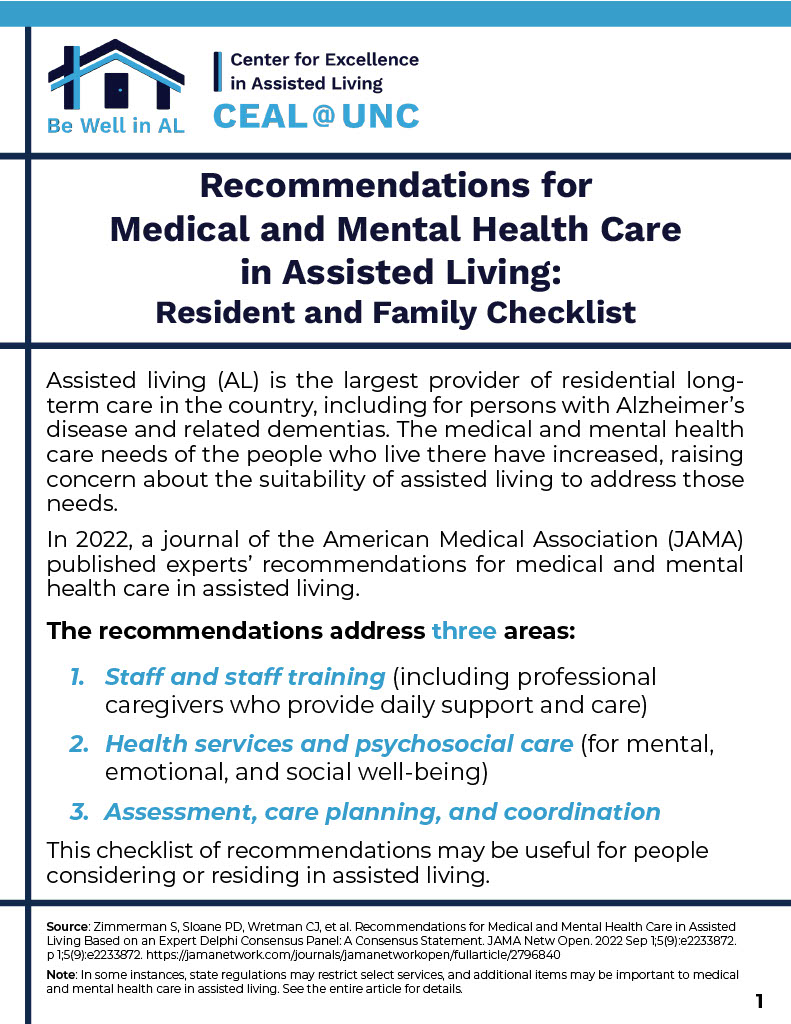
Be Well in AL Recommendations: Resident/Family Checklist
CEAL@UNC recognizes the benefit of ongoing quality improvement in assisted living, including through the implementation of consensus medical and mental health care recommendations disseminated through the Be Well in AL Initiative. This checklist, to be used by residents and their families considering or residing in assisted living, is a helpful tool to understand recommended care […]
Changes in Nursing Staff Levels and Injury-Related Emergency Department Visits among Assisted Living Residents with Alzheimers Disease and Related Dementias
WHAT THIS MEANS FOR YOU: An analysis of 2007-2015 Medicare data for over 12,000 AL residents with ADRD in 455 Ohio AL communities showed that higher levels of RN staffing hours per resident per day led to a 53% decrease in injury-related emergency department visits.
Prevalence and Correlates of Antipsychotic Medication Use in Oregon Assisted Living
WHAT THIS MEANS FOR YOU: An analysis of data from 463 AL communities in Oregon from 2017-2019 revealed that on average, 30.7% of residents had received antipsychotics in the past 90 days. Nonprofit settings had lower usage compared to for-profit settings, while communities with more residents using Medicaid had higher rates of antipsychotic usage. Residents in memory care were more likely to receive these medications than residents in general AL settings.
Serious Mental Illness in Assisted Living Communities: Association with Nursing Home Placement
WHAT THIS MEANS FOR YOU: An analysis of data from over 289,000 Medicare beneficiaries in 17,265 ALs from 2018 to 2019 revealed that over half of AL residents had at least one serious mental illness diagnosis, with major depression being the most common (93%). Residents with schizophrenia or bipolar disorder were statistically significantly less likely to be permanently placed in NHs (as opposed to continued AL residency) respective to the average rate of placement for all residents in the analysis. However, the risk of permanent NH placement was higher for residents with ADRD, including residents with a schizophrenia or bipolar disorder diagnosis.
Bioethics in Gerontology: Developing a Typology of Ethical Issues in Assisted Living
WHAT THIS MEANS FOR YOU: A team of researchers developed a typology of the ethical conflicts that are likely to exist within AL communities. Drawing on data from a 5-year qualitative study in four ALs for validation, this typology aims to help families, staff, and residents identify and understand ethical best practices in AL communities.
Examining Pain, Function, Behavioral Symptoms and Associations with Engagement in Meaningful Activity for Residents with Dementia in Assisted Living
WHAT THIS MEANS FOR YOU: In a study of 71 residents with dementia from 5 AL facilities, pain was linked to lower engagement in meaningful activities (i.e., activities that provide meaning and value to the person based on their individual interests and preferences), even when controlling for age, gender, health conditions, and cognitive capacity.
Do End-of-Life Outcomes Differ by Assisted Living Memory-Care Designation?
WHAT THIS MEANS FOR YOU: An analysis of 15,152 Medicare beneficiaries with ADRD examined end-of-life outcomes (mortality, hospice use, and number of days receiving hospice in the last month of life) for residents who moved to a large (25+ bed) AL between 2016 and 2018. Residents living in memory care units had a statistically significantly higher rate of mortality, higher hospice use, and more days spent receiving hospice in the last month of life than residents in general AL units.
Assisted Living Residents with Dementia: Disparities in Mental Health Services Pre and During COVID-19
WHAT THIS MEANS FOR YOU: The in-person and telehealth mental health visits of over 102,000 Medicare beneficiaries living with ADRD in 13,400 AL communities were analyzed using CMS data from 2019 and 2020. Use of these services is low in this population, but it was found that Black residents and those with dual Medicare/Medicaid eligibility were significantly less likely to use these services pre-, and during, the COVID-19 pandemic; however, there were no significant differences in visits via telemedicine (vs. in-person) for any racial or ethnic group or dual eligibles.
Effect of Immersive Virtual Reality Reminiscence versus Traditional Reminiscence Therapy on Cognitive Function and Psychological Well-being among Older Adults in Assisted Living Facilities: A Randomized Controlled Trial
WHAT THIS MEANS FOR YOU: A study of 60 assisted living residents observed the effects of virtual reality reminiscence and traditional reminiscence therapy on residents’ cognitive function and psychological wellbeing. Compared to a control group, there was a statistically significant increase in cognition and psychological wellbeing in both the reminiscence groups.
Primary Care Telemedicine Use among Assisted Living Residents with Dementia during COVID-19: Race and Dual Enrollment Status
WHAT THIS MEANS FOR YOU: This study used Medicare and CDC datasets to examine telemedicine primary care among 62,000 AL residents with dementia during the first year of the COVID-19 pandemic (2020). During the first three quarters of the pandemic, racially minoritized groups (Black, Hispanic) and Medicare-Medicaid dual eligibles were able to successfully use telemedicine at high rates. Gaps in primary care access between these groups and others (white, non-Medicaid eligible) were reduced due to telemedicine. This could inform CMS decisions about Medicare coverage for telemedicine primary care.
State Variation in Antipsychotic Use Among Assisted Living Residents With Dementia
WHAT THIS MEANS FOR YOU: This study of almost 21,000 AL residents in 2017 revealed that those with dementia were prescribed antipsychotics during about 13% of their time residing in AL. This proportion varied by state, with Hawaii having the lowest prescription rate (8%), and Wyoming having the highest (21%). Variations may be due to state regulation of AL communities, but the study was not able to determine if prescription practices were appropriate and tied to health outcomes.
Psychotropic Medication Prescribing in Assisted Living and Nursing Home Residents with Dementia after the National Partnership
WHAT THIS MEANS FOR YOU: Using Medicare data for over 430,000 assisted living and long-stay nursing home residents, prescriptions for antipsychotic drugs decreased in both settings from 2010-2012 (before the National Partnership to Improve Dementia Care in Nursing Homes) to 2012-2017 (post-Partnership). However, assisted living prescribing decreased at a slower rate than nursing homes, meaning that the Partnership likely did not have a measurable impact in assisted living.
Injury-Related Emergency Department Use among Assisted Living Residents with Alzheimer’s Disease and Related Dementias
WHAT THIS MEANS FOR YOU: Using 2018 Medicare data for over 116,000 residents, residents with dementia had a 25% higher risk of going to the emergency room for injuries compared to those without dementia, as well as having a significantly higher chance of being hospitalized for injuries, regardless of whether they lived in general assisted living or memory care.
Excess Mortality Among Assisted Living Residents with Dementia during the COVID-19 Pandemic
WHAT THIS MEANS FOR YOU: Data from over 560,000 Medicare recipients revealed that residents with dementia experienced 33.4 more excess deaths per 100,000 compared to those without dementia during the COVID-19 pandemic. Residents in memory care communities did not have significantly different mortality rates compared to those in general assisted living settings.
Successful Aging in Assisted Living: The Importance of Near Visual Acuity
Successful aging among independent community-dwelling older adults and those in residential settings is paramount to aging in place. The purpose of the current study was to explore how sensory, cognitive, and functional impairments affect successful aging in assisted living (AL) settings. Vision compromise was noted for near visual acuity (NVA) (14.3%) and distance visual acuity […]